ポロニウム (Po)
メタロイド · 固体 · 周期 6 · 族 16

元素の性質
- 原子番号
- 84
- シンボル
- Po
- 原子質量
- 208.9824
- カテゴリ
- メタロイド
- 標準状態
- 固体
- 周期
- 6
- 族
- 16
- 電気陰性
- 2
- 原子半径
- 197
- イオン化エネルギー
- 8.42
- 電子親和力
- 1.9
- 酸化数
- +4, +2
- 融点
- 527 K (253.85 °C)
- 沸点
- 1235 K (961.85 °C)
- 密度
- 9.32
- 電子配置
- [Xe]6s2 4f14 5d10 6p4
- 発見年
- 1898
電子殻
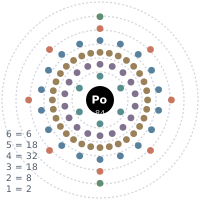
[Xe]6s2 4f14 5d10 6p4
電子は核の周りに殻(主エネルギーレベル)で配置されています。この図は概略図であり、同じ殻の軌道は別々に描かれていません。
ポロニウムについて
Polonium is a chemical element; it has symbol Po and atomic number 84. A rare and highly radioactive metal with no stable isotopes, polonium is a chalcogen and chemically similar to selenium and tellurium, though its metallic character resembles that of its horizontal neighbours in the periodic table: thallium, lead, and bismuth. Due to the short half-life of all its isotopes, its natural occurrence is limited to tiny traces of the fleeting polonium-210 in uranium ores, as it is the penultimate daughter of natural uranium-238. Though two longer-lived isotopes exist, they are much more difficult to produce. Today, polonium is usually produced in milligram quantities by the neutron irradiation of bismuth. Due to its intense radioactivity, which results in the radiolysis of chemical bonds and radioactive self-heating, its chemistry has mostly been investigated on the trace scale only.
発見の経緯
発見: 1898
Tentatively called "radium F", polonium was discovered by Marie and Pierre Curie in July 1898, and was named after Marie Curie's native land of Poland (Latin: Polonia). Poland at the time was under Russian, German, and Austro-Hungarian partition, and did not exist as an independent country. It was Curie's hope that naming the element after her native land would publicize its lack of independence. Polonium may be the first element named to highlight a political controversy. This element was the first one discovered by the Curies while they were investigating the cause of pitchblende radioactivity. Pitchblende, after removal of the radioactive elements uranium and thorium, was more radioactive than the uranium and thorium combined. This spurred the Curies to search for additional radioactive elements. They first separated out polonium from pitchblende in July 1898, and five months later, a
用途と応用
Polonium has no common compounds, and almost all of its compounds are synthetically created; more than 50 of those are known. The most stable class of polonium compounds are polonides, which are prepared by direct reaction of two elements. Na2Po has the antifluorite structure, the polonides of Ca, Ba, Hg, Pb and lanthanides form a NaCl lattice, BePo and CdPo have the wurtzite and MgPo the nickel arsenide structure. Most polonides decompose upon heating to about 600 °C, except for HgPo that decomposes at ~300 °C and the lanthanide polonides, which do not decompose but melt at temperatures above 1000 °C. For example, the polonide of praseodymium (PrPo) melts at 1250 °C, and that of thulium (TmPo) melts at 2200 °C. PbPo is one of the very few naturally occurring polonium compounds, as polonium alpha decays to form lead. Polonium hydride (PoH2) is a volatile liquid at room temperature prone
同位体
All nuclear data not otherwise stated is from the standard source: There are 42 known isotopes of polonium (84Po), all radioactive, stretching from 186Po to 227Po. The isotopes 210 through 218 occur naturally in the four principal decay chains. In terms of curies they are mostly of even mass number, coming from uranium-238 and thorium-232, with smaller amounts of 211 and 215 from uranium-235, and very little with mass number 213 coming from neptunium-237, and much less with mass number 217 coming from a rare branch of the neptunium decay chain. 210Po has the longest half-life by far (138.376 days) and is, therefore, the most abundant by far in terms of moles or mass. It is also the most easily synthesized isotope, by neutron capture on natural bismuth, and so by far the most abundant artificial isotope as well. Two other isotopes have longer lives: 209Po with a half-life of 124 years and
広告
よくある質問
ポロニウムの原子番号はいくつですか?
ポロニウムの原子番号は84で、原子核内の陽子の数に等しくなります。
ポロニウムの原子量はいくらですか?
ポロニウムの原子量は約208.9824 uです(炭素-12原子量の12分の1を基準とします)。
ポロニウムの電子配置はどうですか?
ポロニウムの電子配置は[Xe]6s2 4f14 5d10 6p4です。
ポロニウムは周期表のどこにありますか?
ポロニウムは第6周期、第16族に位置します。
ポロニウムはいつ発見されましたか?
ポロニウムは1898に発見されました。