Seaborgium (Sg)
Transition Metals · Solid · Period 7 · Group 6
Element Properties
- Atomic Number
- 106
- Symbol
- Sg
- Atomic Mass
- 269.128
- Category
- Transition Metals
- Standard State
- Solid
- Period
- 7
- Group
- 6
- Electronegativity
- —
- Atomic Radius
- —
- Ionization Energy
- —
- Electron Affinity
- —
- Oxidation States
- 6, 5, 4, 3, 0
- Melting Point
- —
- Boiling Point
- —
- Density
- —
- Electron Configuration
- [Rn]7s2 5f14 6d4
- Year Discovered
- 1974
Electron shells
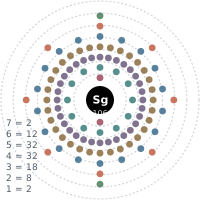
[Rn]7s2 5f14 6d4
Electrons are arranged in shells (principal energy levels) around the nucleus. The diagram is a schematic — orbitals in the same shell are not drawn separately.
About Seaborgium
Seaborgium is a synthetic chemical element; it has symbol Sg and atomic number 106. It is named after the American nuclear chemist Glenn T. Seaborg. As a synthetic element, it can be created in a laboratory but is not found in nature. It is also radioactive; the most stable known isotopes have half-lives on the order of several minutes.
Discovery & history
Discovered: 1974 · Yuri Oganessian
Following claims of the observation of elements 104 and 105 in 1970 by Albert Ghiorso et al. at the Lawrence Livermore National Laboratory, a search for element 106 using oxygen-18 projectiles and the previously used californium-249 target was conducted. Several 9.1 MeV alpha decays were reported and are now thought to originate from element 106, though this was not confirmed at the time. In 1972, the HILAC accelerator received equipment upgrades, preventing the team from repeating the experiment, and data analysis was not done during the shutdown. This reaction was tried again several years later, in 1974, and the Berkeley team realized that their new data agreed with their 1971 data, to the astonishment of Ghiorso. Hence, element 106 could have actually been discovered in 1971 if the original data was analyzed more carefully. Two groups claimed discovery of the element. Evidence of ele
Isotopes
Superheavy elements such as seaborgium are produced by bombarding lighter elements in particle accelerators that induces fusion reactions. Whereas most of the isotopes of seaborgium can be synthesized directly this way, some heavier ones have only been observed as decay products of elements with higher atomic numbers. Depending on the energies involved, fusion reactions that generate superheavy elements are separated into "hot" and "cold". In hot fusion reactions, very light, high-energy projectiles are accelerated toward very heavy targets (actinides), giving rise to compound nuclei at high excitation energy (~40–50 MeV) that may either fission or evaporate several (3 to 5) neutrons. In cold fusion reactions, the produced fused nuclei have a relatively low excitation energy (~10–20 MeV), which decreases the probability that these products will undergo fission reactions. As the fused nuc
Advertisement
Frequently asked questions
What is the atomic number of Seaborgium?
The atomic number of Seaborgium is 106, which equals the number of protons in its nucleus.
What is the atomic mass of Seaborgium?
The atomic mass of Seaborgium is approximately 269.128 u (one twelfth of the mass of a carbon-12 atom).
What is the electron configuration of Seaborgium?
The electron configuration of Seaborgium is [Rn]7s2 5f14 6d4.
Where is Seaborgium in the periodic table?
Seaborgium is located in period 7, group 6.
When was Seaborgium discovered?
Seaborgium was discovered in 1974.