Chromium (Cr)
Transition Metals · Solid · Period 4 · Group 6

Element Properties
- Atomic Number
- 24
- Symbol
- Cr
- Atomic Mass
- 51.996
- Category
- Transition Metals
- Standard State
- Solid
- Period
- 4
- Group
- 6
- Electronegativity
- 1.66
- Atomic Radius
- 189
- Ionization Energy
- 6.77
- Electron Affinity
- 0.67
- Oxidation States
- +6, +3, +2
- Melting Point
- 2180 K (1906.85 °C)
- Boiling Point
- 2944 K (2670.85 °C)
- Density
- 7.15
- Electron Configuration
- [Ar]3d5 4s1
- Year Discovered
- 1797
Electron shells
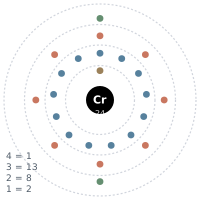
[Ar]3d5 4s1
Electrons are arranged in shells (principal energy levels) around the nucleus. The diagram is a schematic — orbitals in the same shell are not drawn separately.
About Chromium
Chromium is a chemical element; it has symbol Cr and atomic number 24. It is the first element in group 6. It is a steely-grey, lustrous, hard, and brittle transition metal.
Discovery & history
Discovered: 1797 · Louis Nicolas Vauquelin
Chromium was not used anywhere until the experiments of French pharmacist and chemist Nicolas Louis Vauquelin (1763–1829) in the late 1790s. From the 1970s, until 2019, it was widely believed that the technique of chromium plating to prevent metal corrosion had been invented in ancient China. This technique was thought to have been used, for example, to protect bronze artifacts such as arrowheads and sword blades buried as grave goods in the mausoleum of the First Emperor of Qin. However, a detailed scientific investigation in 2019 revealed that the chromium found on these artifacts originated naturally from the lacquer applied to them. Scientists now believe that the excellent preservation of the artifacts was not due to intentional chromium plating, but rather to the burial environment: the soil was fine-grained and alkaline, which limited aeration and the growth of organic matter, the
Uses & applications
Chromium is a member of group 6, of the transition metals. The +3 and +6 states occur most commonly within chromium compounds, followed by +2; charges of +1, +4 and +5 for chromium are rare, but do nevertheless occasionally exist.
Isotopes
Naturally occurring chromium is composed of four stable isotopes; 50Cr, 52Cr, 53Cr and 54Cr, with 52Cr being the most abundant (83.789% natural abundance). Twenty-five radioisotopes have been characterized, ranging from 42Cr to 70Cr; the most stable radioisotope is 51Cr with a half-life of 27.70 days. All of the remaining radioactive isotopes have half-lives that are less than a day and the majority less than a minute. Chromium also has two metastable nuclear isomers. The primary decay mode before the most abundant stable isotope, 52Cr, is electron capture and the primary mode after is beta decay. 53Cr is the radiogenic decay product of 53Mn (half-life 3.7 million years). Chromium and manganese are found together sufficiently for measurement of both to find application in isotope geology. Manganese-chromium isotope ratios reinforce the evidence from 26Al and 107Pd concerning the early hi
Advertisement
Frequently asked questions
What is the atomic number of Chromium?
The atomic number of Chromium is 24, which equals the number of protons in its nucleus.
What is the atomic mass of Chromium?
The atomic mass of Chromium is approximately 51.996 u (one twelfth of the mass of a carbon-12 atom).
What is the electron configuration of Chromium?
The electron configuration of Chromium is [Ar]3d5 4s1.
Where is Chromium in the periodic table?
Chromium is located in period 4, group 6.
When was Chromium discovered?
Chromium was discovered in 1797.