Molybdenum (Mo)
Transition Metals · Solid · Period 5 · Group 6

Element Properties
- Atomic Number
- 42
- Symbol
- Mo
- Atomic Mass
- 95.95
- Category
- Transition Metals
- Standard State
- Solid
- Period
- 5
- Group
- 6
- Electronegativity
- 2.16
- Atomic Radius
- 209
- Ionization Energy
- 7.09
- Electron Affinity
- 0.75
- Oxidation States
- +6
- Melting Point
- 2896 K (2622.85 °C)
- Boiling Point
- 4912 K (4638.85 °C)
- Density
- 10.2
- Electron Configuration
- [Kr]5s1 4d5
- Year Discovered
- 1778
Electron shells
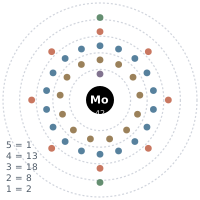
[Kr]5s1 4d5
Electrons are arranged in shells (principal energy levels) around the nucleus. The diagram is a schematic — orbitals in the same shell are not drawn separately.
About Molybdenum
Molybdenum is a chemical element; it has symbol Mo and atomic number 42. The name is derived from Ancient Greek μόλυβδος mólybdos, meaning lead, since its ores were sometimes confused with those of lead. Molybdenum minerals have been known throughout history, but the element was discovered in 1778 by Carl Wilhelm Scheele. The metal was first isolated in 1781 by Peter Jacob Hjelm.
Discovery & history
Discovered: 1778 · Carl Wilhelm Scheele
Molybdenite—the principal ore from which molybdenum is now extracted—was previously known as molybdena. Molybdena was confused with and often used as though it were graphite. Like graphite, molybdenite can be used to blacken a surface or as a solid lubricant. Even when molybdena was distinguishable from graphite, it was still confused with the common lead ore PbS (now called galena); the name comes from Ancient Greek μόλυβδος mólybdos, meaning lead. (The Greek word itself has been proposed as a loanword from Anatolian Luvian and Lydian languages). Although (reportedly) molybdenum was deliberately alloyed with steel in one 14th-century Japanese sword (mfd. c. 1330), that art was never employed widely and was later lost. In the West in 1754, Bengt Andersson Qvist examined a sample of molybdenite and determined that it did not contain lead and thus was not galena. By 1778 Swedish chemist Ca
Uses & applications
Molybdenum forms chemical compounds in oxidation states −4 and from −2 to +6. Higher oxidation states are more relevant to its terrestrial occurrence and its biological roles, mid-level oxidation states are often associated with metal clusters, and very low oxidation states are typically associated with organomolybdenum compounds. The chemistry of molybdenum and tungsten show strong similarities. The relative rarity of molybdenum(III), for example, contrasts with the pervasiveness of the chromium(III) compounds. The highest oxidation state is seen in molybdenum(VI) oxide (MoO3), whereas the normal sulfur compound is molybdenum disulfide MoS2.
Isotopes
There are 39 known isotopes of molybdenum, ranging in atomic mass from 81 to 119, as well as 13 metastable nuclear isomers. Seven isotopes occur naturally, with atomic masses of 92, 94, 95, 96, 97, 98, and 100. Molybdenum-98 is the most abundant, comprising 24.14% of natural molybdenum, and only molybdenum-100 is unstable; it undergoes double beta decay into ruthenium-100 with half-life 7.07×10¹⁸ years. All the synthetic isotopes of molybdenum decay into isotopes of niobium, technetium, or zirconium. The most stable of them is 93Mo, with a half-life of 4,839 years to electron capture, giving stable niobium. The most common isotopic molybdenum application involves molybdenum-99, which is a fission product. It is a parent radioisotope to the short-lived gamma-emitting daughter radioisotope technetium-99m, a nuclear isomer used in various imaging applications in medicine.
Advertisement
Frequently asked questions
What is the atomic number of Molybdenum?
The atomic number of Molybdenum is 42, which equals the number of protons in its nucleus.
What is the atomic mass of Molybdenum?
The atomic mass of Molybdenum is approximately 95.95 u (one twelfth of the mass of a carbon-12 atom).
What is the electron configuration of Molybdenum?
The electron configuration of Molybdenum is [Kr]5s1 4d5.
Where is Molybdenum in the periodic table?
Molybdenum is located in period 5, group 6.
When was Molybdenum discovered?
Molybdenum was discovered in 1778.