Radium (Ra)
Alkaline Earth Metals · Solid · Period 7 · Group 2

Element Properties
- Atomic Number
- 88
- Symbol
- Ra
- Atomic Mass
- 226.0254
- Category
- Alkaline Earth Metals
- Standard State
- Solid
- Period
- 7
- Group
- 2
- Electronegativity
- 0.9
- Atomic Radius
- 283
- Ionization Energy
- 5.28
- Electron Affinity
- —
- Oxidation States
- +2
- Melting Point
- 973 K (699.85 °C)
- Boiling Point
- 1413 K (1139.85 °C)
- Density
- 5
- Electron Configuration
- [Rn]7s2
- Year Discovered
- 1898
Electron shells
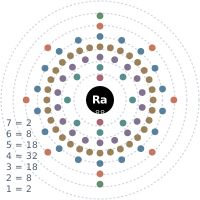
[Rn]7s2
Electrons are arranged in shells (principal energy levels) around the nucleus. The diagram is a schematic — orbitals in the same shell are not drawn separately.
About Radium
Radium is a chemical element; it has symbol Ra and atomic number 88. It is the sixth element in group 2 of the periodic table, also known as the alkaline earth metals. Pure radium is silvery-white, but it readily reacts with nitrogen (rather than oxygen) upon exposure to air, forming a black surface layer of radium nitride (Ra3N2). All isotopes of radium are radioactive, the most stable isotope being radium-226 with a half-life of 1,600 years. When radium decays, it emits ionizing radiation as a by-product, which can excite fluorescent chemicals and cause radioluminescence. For this property, it was widely used in self-luminous paints following its discovery. Of the radioactive elements that occur in quantity, radium is considered particularly toxic, and it is carcinogenic due to the radioactivity of both it and its immediate decay product radon as well as its tendency to accumulate in the bones.
Discovery & history
Discovered: 1898
Radium was discovered by Marie Skłodowska-Curie and her husband Pierre Curie on 21 December 1898 in a uraninite (pitchblende) sample from Jáchymov. While studying the mineral earlier, the Curies removed uranium from it and found that the remaining material was still radioactive. In July 1898, while studying pitchblende, they isolated an element similar to bismuth which turned out to be polonium. They then isolated a radioactive mixture consisting of two components: compounds of barium, which gave a brilliant green flame color, and unknown radioactive compounds which gave carmine spectral lines that had never been documented before. The Curies found the radioactive compounds to be very similar to the barium compounds, except they were less soluble. This discovery made it possible for the Curies to isolate the radioactive compounds and discover a new element in them. The Curies announced t
Uses & applications
Solid radium compounds are white as radium ions provide no specific coloring, but they gradually turn yellow and then dark over time due to self-radiolysis from radium's alpha decay. Insoluble radium compounds coprecipitate with all barium, most strontium, and most lead compounds. Radium oxide (RaO) is poorly characterized, as the reaction of radium with air results in the formation of radium nitride. Radium hydroxide (Ra(OH)2) is formed via the reaction of radium metal with water, and is the most readily soluble among the alkaline earth hydroxides and a stronger base than its barium congener, barium hydroxide. It is also more soluble than actinium hydroxide and thorium hydroxide: these three adjacent hydroxides may be separated by precipitating them with ammonia. Radium chloride (RaCl2) is a colorless, luminescent compound. It becomes yellow after some time due to self-damage by the alp
Isotopes
Radium has 33 known isotopes with mass numbers from 202 to 234, all of which are radioactive. Four of these – 223Ra (half-life 11.4 days), 224Ra (3.64 days), 226Ra (1600 years), and 228Ra (5.75 years) – occur naturally in the decay chains of primordial thorium-232, uranium-235, and uranium-238 (223Ra from uranium-235, 226Ra from uranium-238, and the other two from thorium-232). These isotopes nevertheless still have half-lives too short to be primordial radionuclides, and only exist in nature from these decay chains. Together with the mostly artificial 225Ra (15 d), which occurs in nature only as a decay product of minute traces of neptunium-237, these are the five most stable isotopes of radium. All other 27 known radium isotopes have half-lives under two hours, and the majority have half-lives under a minute. Of these, 221Ra (half-life 28 s) also occurs as a 237Np daughter, and 220Ra a
Advertisement
Frequently asked questions
What is the atomic number of Radium?
The atomic number of Radium is 88, which equals the number of protons in its nucleus.
What is the atomic mass of Radium?
The atomic mass of Radium is approximately 226.0254 u (one twelfth of the mass of a carbon-12 atom).
What is the electron configuration of Radium?
The electron configuration of Radium is [Rn]7s2.
Where is Radium in the periodic table?
Radium is located in period 7, group 2.
When was Radium discovered?
Radium was discovered in 1898.