Neptunium (Np)
Actinides · Solid · Period 7 · Group 3

Element Properties
- Atomic Number
- 93
- Symbol
- Np
- Atomic Mass
- 237.0482
- Category
- Actinides
- Standard State
- Solid
- Period
- 7
- Group
- 3
- Electronegativity
- 1.36
- Atomic Radius
- 221
- Ionization Energy
- 6.27
- Electron Affinity
- —
- Oxidation States
- +6, +5, +4, +3
- Melting Point
- 917 K (643.85 °C)
- Boiling Point
- 4175 K (3901.85 °C)
- Density
- 20.25
- Electron Configuration
- [Rn]7s2 5f4 6d1
- Year Discovered
- 1940
Electron shells
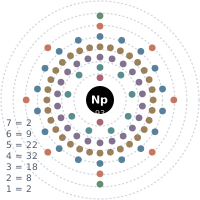
[Rn]7s2 5f4 6d1
Electrons are arranged in shells (principal energy levels) around the nucleus. The diagram is a schematic — orbitals in the same shell are not drawn separately.
About Neptunium
Neptunium is a chemical element; it has the chemical symbol Np and atomic number 93. A radioactive actinide metal, neptunium is the first transuranic element. It is named after Neptune, the planet beyond Uranus in the Solar System, which uranium is named after. A neptunium atom has 93 protons and 93 electrons, of which seven are valence electrons. Neptunium metal is silvery and tarnishes when exposed to air. The element occurs in three allotropic forms and it normally exhibits five oxidation states, ranging from +3 to +7. Like all actinides, it is radioactive, poisonous, pyrophoric, and capable of accumulating in bones, which makes the handling of neptunium dangerous.
Discovery & history
Discovered: 1940 · Edwin McMillan
When the first periodic table of the elements was published by Dmitri Mendeleev in the early 1870s, it showed a " — " in place after uranium similar to several other places for then-undiscovered elements. Other subsequent tables of known elements, including a 1913 publication of the known radioactive isotopes by Kasimir Fajans, also show an empty place after uranium, element 92. Up to and after the discovery of the final component of the atomic nucleus, the neutron in 1932, most scientists did not seriously consider the possibility of elements heavier than uranium. While nuclear theory at the time did not explicitly prohibit their existence, there was little evidence to suggest that they did. However, the discovery of induced radioactivity by Irène and Frédéric Joliot-Curie in late 1933 opened up an entirely new method of researching the elements and inspired a small group of Italian sci
Uses & applications
The longest-lived isotope of neptunium, 237Np, has a half-life of 2.14 million years, which is more than 2,000 times shorter than the age of the Earth. Therefore, any primordial neptunium would have decayed in the distant past. After only about 80 million years, the concentration of even the longest-lived isotope, 237Np, would have been reduced to less than one-trillionth (10−12) of its original amount. Thus neptunium is present in nature only in negligible amounts produced as intermediate decay products of other isotopes. Trace amounts of the neptunium isotopes neptunium-237 and -239 are found naturally as decay products from transmutation reactions in uranium ores. 239Np and 237Np are the most common of these isotopes; they are directly formed from neutron capture by uranium-238 atoms. These neutrons come from the spontaneous fission of uranium-238, naturally neutron-induced fission of
Isotopes
All nuclear data not otherwise stated is from the standard source: Twenty-four neptunium radioisotopes have been characterized, with the most stable being 237Np with a half-life of 2.144 million years, 236Np with a half-life of 153,000 years, and 235Np with a half-life of 396.1 days. All of the remaining radioactive isotopes have half-lives that are less than 5 days. Isotopes lighter than the most stable one, 237Np, decay primarily by electron capture, although some also decay by alpha emission to become protactinium. 237Np itself, being the beta-stable isobar of mass number 237, decays by alpha to 233Pa, with very rare spontaneous fission. Heavier isotopes generally decay by beta emission. The decay of 237Np eventually yields bismuth-209 and thallium-205, unlike most other common heavy nuclei which decay into isotopes of lead. This decay chain is known as the neptunium series. This deca
Advertisement
Frequently asked questions
What is the atomic number of Neptunium?
The atomic number of Neptunium is 93, which equals the number of protons in its nucleus.
What is the atomic mass of Neptunium?
The atomic mass of Neptunium is approximately 237.0482 u (one twelfth of the mass of a carbon-12 atom).
What is the electron configuration of Neptunium?
The electron configuration of Neptunium is [Rn]7s2 5f4 6d1.
Where is Neptunium in the periodic table?
Neptunium is located in period 7, group 3.
When was Neptunium discovered?
Neptunium was discovered in 1940.