Thallium (Tl)
Post-transition Metals · Solid · Period 6 · Group 13

Element Properties
- Atomic Number
- 81
- Symbol
- Tl
- Atomic Mass
- 204.383
- Category
- Post-transition Metals
- Standard State
- Solid
- Period
- 6
- Group
- 13
- Electronegativity
- 1.62
- Atomic Radius
- 196
- Ionization Energy
- 6.11
- Electron Affinity
- 0.2
- Oxidation States
- +3, +1
- Melting Point
- 577 K (303.85 °C)
- Boiling Point
- 1746 K (1472.85 °C)
- Density
- 11.8
- Electron Configuration
- [Xe]6s2 4f14 5d10 6p1
- Year Discovered
- 1861
Electron shells
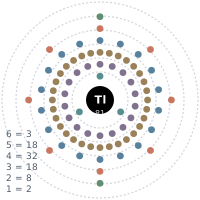
[Xe]6s2 4f14 5d10 6p1
Electrons are arranged in shells (principal energy levels) around the nucleus. The diagram is a schematic — orbitals in the same shell are not drawn separately.
About Thallium
Thallium is a chemical element; it has symbol Tl and atomic number 81. It is a silvery-white post-transition metal that is not found free in nature. When isolated, thallium resembles tin, but discolors when exposed to air. Chemists William Crookes and Claude-Auguste Lamy discovered thallium independently in 1861, in residues of sulfuric acid production. Both used the newly developed method of flame spectroscopy, in which thallium produces a notable green spectral line. Thallium, from Greek θαλλός, thallós, meaning "green shoot" or "twig", was named by Crookes. It was isolated by both Lamy and Crookes in 1862, Lamy by electrolysis and Crookes by precipitation and melting of the resultant powder. Crookes exhibited it as a powder precipitated by zinc at the International Exhibition, which opened on 1 May that year.
Discovery & history
Discovered: 1861 · Claude-Auguste Lamy
Thallium (Greek θαλλός, thallos, meaning "a green shoot or twig") was discovered by William Crookes and Claude Auguste Lamy, working independently, both using flame spectroscopy (Crookes was first to publish his findings, on March 30, 1861). The name comes from thallium's bright green spectral emission lines. After the publication of the improved method of flame spectroscopy by Robert Bunsen and Gustav Kirchhoff and the discovery of caesium and rubidium in the years 1859 to 1860, flame spectroscopy became an approved method to determine the composition of minerals and chemical products. Crookes and Lamy both started to use the new method. Crookes used it to make spectroscopic determinations for tellurium on selenium compounds deposited in the lead chamber of a sulfuric acid production plant near Tilkerode in the Harz mountains. He had obtained the samples for his research on selenium cya
Uses & applications
Thallium(III) compounds resemble the corresponding aluminium(III) compounds. They are moderately strong oxidizing agents and are usually unstable, as illustrated by the positive reduction potential for the Tl3+/Tl couple. Some mixed-valence compounds are also known, such as Tl4O3 and TlCl2, which contain both thallium(I) and thallium(III). The simplest possible thallium compound, thallane (TlH3), is too unstable to exist in bulk, both due to the instability of the +3 oxidation state as well as poor overlap of the valence 6s and 6p orbitals of thallium with the 1s orbital of hydrogen. The trihalides are more stable, although they are chemically distinct from those of the lighter group 13 elements and are still the least stable in the whole group. For instance, thallium(III) fluoride, TlF3, but not the lighter group 13 trifluorides, has the β−BiF3 structure and does not form the TlF4− com
Isotopes
Thallium has 41 known isotopes with atomic masses from 176 to 216. 203Tl and 205Tl are the only stable isotopes and make up all natural thallium. The five short-lived isotopes 206Tl through 210Tl inclusive occur in nature, but only as part of the natural decay chains of heavier elements. 204Tl is the most stable radioisotope, with a half-life of 3.78 years; the next most stable are 202Tl (half-life 12.31 days) and 201Tl (half-life 3.0421 days). It is made by the neutron activation of stable thallium in a nuclear reactor. The isotope 201Tl is useful in nuclear medicine; it decays by electron capture, emitting X-rays (~70–80 keV), and gamma rays of 135 and 167 keV; therefore, it has good imaging characteristics without an excessive patient-radiation dose. It is the most popular isotope used for thallium nuclear cardiac stress tests.
Advertisement
Frequently asked questions
What is the atomic number of Thallium?
The atomic number of Thallium is 81, which equals the number of protons in its nucleus.
What is the atomic mass of Thallium?
The atomic mass of Thallium is approximately 204.383 u (one twelfth of the mass of a carbon-12 atom).
What is the electron configuration of Thallium?
The electron configuration of Thallium is [Xe]6s2 4f14 5d10 6p1.
Where is Thallium in the periodic table?
Thallium is located in period 6, group 13.
When was Thallium discovered?
Thallium was discovered in 1861.