Samarium (Sm)
Lanthanides · Solid · Period 6 · Group 3

Element Properties
- Atomic Number
- 62
- Symbol
- Sm
- Atomic Mass
- 150.4
- Category
- Lanthanides
- Standard State
- Solid
- Period
- 6
- Group
- 3
- Electronegativity
- 1.17
- Atomic Radius
- 229
- Ionization Energy
- 5.64
- Electron Affinity
- —
- Oxidation States
- +3, +2
- Melting Point
- 1347 K (1073.85 °C)
- Boiling Point
- 2067 K (1793.85 °C)
- Density
- 7.52
- Electron Configuration
- [Xe]6s2 4f6
- Year Discovered
- 1879
Electron shells
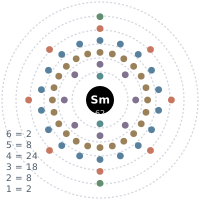
[Xe]6s2 4f6
Electrons are arranged in shells (principal energy levels) around the nucleus. The diagram is a schematic — orbitals in the same shell are not drawn separately.
About Samarium
Samarium is a chemical element; it has symbol Sm and atomic number 62. It is a moderately hard silvery metal that slowly oxidizes in air. Being a typical member of the lanthanide series, samarium usually has the oxidation state +3. Compounds of samarium(II) are also known, most notably the monoxide SmO, monochalcogenides SmS, SmSe and SmTe, as well as samarium(II) iodide.
Discovery & history
Discovered: 1879 · Paul-Émile Lecoq de Boisbaudran
Detection of samarium and related elements was announced by several scientists in the second half of the 19th century; however, most sources give priority to French chemist Paul-Émile Lecoq de Boisbaudran. Boisbaudran isolated samarium oxide and/or hydroxide in Paris in 1879 from the mineral samarskite ((Y,Ce,U,Fe)3(Nb,Ta,Ti)5O16) and identified a new element in it via sharp optical absorption lines. Swiss chemist Marc Delafontaine announced a new element decipium (from Latin: decipiens meaning "deceptive, misleading") in 1878, but later in 1880–1881 demonstrated that it was a mix of several elements, one being identical to Boisbaudran's samarium. Though samarskite was first found in the Ural Mountains in Russia, by the late 1870s it had been found in other places, making it available to many researchers. In particular, it was found that the samarium isolated by Boisbaudran was also impu
Uses & applications
The most stable oxide of samarium is the sesquioxide Sm2O3. Like many samarium compounds, it exists in several crystalline phases. The trigonal form is obtained by slow cooling from the melt. The melting point of Sm2O3 is high (2345 °C), so it is usually melted not by direct heating, but with induction heating, through a radio-frequency coil. Sm2O3 crystals of monoclinic symmetry can be grown by the flame fusion method (Verneuil process) from Sm2O3 powder, that yields cylindrical boules up to several centimeters long and about one centimeter in diameter. The boules are transparent when pure and defect-free and are orange otherwise. Heating the metastable trigonal Sm2O3 to 1,900 °C (3,450 °F) converts it to the more stable monoclinic phase. Cubic Sm2O3 has also been described. Samarium is one of the few lanthanides that form a monoxide, SmO. This lustrous golden-yellow compound was obtain
Isotopes
Naturally occurring samarium is composed of five stable isotopes: 144Sm, 149Sm, 150Sm, 152Sm and 154Sm, and two extremely long-lived radioisotopes, 147Sm (half-life t1/2 = 1.066×10¹¹ years) and 148Sm (6.3×10¹⁵ years), with 152Sm being the most abundant (26.75%). 149Sm is listed by various sources as being stable, but some sources state that it is radioactive; the lower bound on its half-life is 2×10¹⁵ years. Some observationally stable samarium isotopes are predicted to decay to isotopes of neodymium. The long-lived isotopes 146Sm, 147Sm, and 148Sm (and 149Sm if it decays) undergo alpha decay to neodymium isotopes. Lighter unstable isotopes of samarium mainly decay by electron capture to promethium, while heavier ones beta decay to europium. The known isotopes range from 129Sm to 168Sm. The half-lives of 151Sm and 145Sm are 94.6 years and 340 days, respectively. All remaining radioisotop
Advertisement
Frequently asked questions
What is the atomic number of Samarium?
The atomic number of Samarium is 62, which equals the number of protons in its nucleus.
What is the atomic mass of Samarium?
The atomic mass of Samarium is approximately 150.4 u (one twelfth of the mass of a carbon-12 atom).
What is the electron configuration of Samarium?
The electron configuration of Samarium is [Xe]6s2 4f6.
Where is Samarium in the periodic table?
Samarium is located in period 6, group 3.
When was Samarium discovered?
Samarium was discovered in 1879.