Promethium (Pm)
Lanthanides · Solid · Period 6 · Group 3

Element Properties
- Atomic Number
- 61
- Symbol
- Pm
- Atomic Mass
- 144.9128
- Category
- Lanthanides
- Standard State
- Solid
- Period
- 6
- Group
- 3
- Electronegativity
- —
- Atomic Radius
- 236
- Ionization Energy
- 5.55
- Electron Affinity
- —
- Oxidation States
- +3
- Melting Point
- 1315 K (1041.85 °C)
- Boiling Point
- 3273 K (2999.85 °C)
- Density
- 7.26
- Electron Configuration
- [Xe]6s2 4f5
- Year Discovered
- 1945
Electron shells
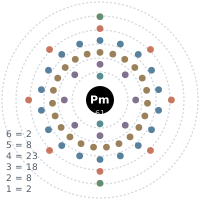
[Xe]6s2 4f5
Electrons are arranged in shells (principal energy levels) around the nucleus. The diagram is a schematic — orbitals in the same shell are not drawn separately.
About Promethium
Promethium is a generally synthetic chemical element; it has symbol Pm and atomic number 61. All of its isotopes are radioactive; it is extremely rare, with only about 500–600 grams naturally occurring in the Earth's crust at any given time. Promethium is one of only two radioactive elements that are both preceded and succeeded in the periodic table by elements with stable forms, the other being technetium. Chemically, promethium is a lanthanide. Promethium shows only one stable oxidation state of +3.
Discovery & history
Discovered: 1945 · Jacob Akiba Marinsky
In 1902, Czech chemist Bohuslav Brauner found out that the differences in properties between neodymium and samarium were the largest between any two consecutive lanthanides in the sequence then known; as a conclusion, he suggested there was an element with intermediate properties between them. This prediction was supported in 1914 by Henry Moseley who, having discovered that atomic number was an experimentally measurable property of elements, found that a few atomic numbers had no known corresponding elements: the gaps were 43, 61, 72, 75, 85, and 87. With the knowledge of a gap in the periodic table several groups started to search for the predicted element among other rare earths in the natural environment. The first claim of a discovery was published by Luigi Rolla and Lorenzo Fernandes of Florence, Italy. After separating a mixture of a few rare earth elements nitrate concentrate fro
Uses & applications
Promethium belongs to the cerium group of lanthanides and is chemically very similar to the neighboring elements. Because of its instability, chemical studies of promethium are incomplete. Even though a few compounds have been synthesized, they are not fully studied; in general, they tend to be pink or red in color. In May 2024, a promethium coordination complex with neutral PyDGA ligands was characterized in aqueous solution. Treatment of acidic solutions containing Pm3+ ions with ammonia results in a gelatinous light-brown sediment of hydroxide, Pm(OH)3, which is insoluble in water. When dissolved in hydrochloric acid, a water-soluble yellow salt, PmCl3, is produced; similarly, when dissolved in nitric acid, a nitrate results, Pm(NO3)3. The latter is also well-soluble; when dried, it forms pink crystals, similar to Nd(NO3)3. The electron configuration for Pm3+ is [Xe] 4f4, and the colo
Isotopes
Promethium is the only lanthanide and one of only two elements among the first 83 with no stable or long-lived (primordial) isotopes. This is a result of a rarely occurring effect of the liquid drop model of the nucleus and stabilities of neighbor element isotopes; it is also the least stable element of the first 84 elements. The primary decay products are neodymium and samarium isotopes (promethium-146 decays to both, the lighter isotopes generally to neodymium via positron decay and electron capture, and the heavier isotopes to samarium via beta decay). Promethium nuclear isomers may decay to other promethium isotopes and one isotope (145Pm) has a very rare alpha decay mode to stable praseodymium-141. The most stable isotope of the element is promethium-145, which has a specific activity of 139 Ci/g (5.1 TBq/g) and a half-life of 17.7 years via electron capture. Because it has 84 neutr
Advertisement
Frequently asked questions
What is the atomic number of Promethium?
The atomic number of Promethium is 61, which equals the number of protons in its nucleus.
What is the atomic mass of Promethium?
The atomic mass of Promethium is approximately 144.9128 u (one twelfth of the mass of a carbon-12 atom).
What is the electron configuration of Promethium?
The electron configuration of Promethium is [Xe]6s2 4f5.
Where is Promethium in the periodic table?
Promethium is located in period 6, group 3.
When was Promethium discovered?
Promethium was discovered in 1945.