Flerovium (Fl)
Post-transition Metals · Expected to be a solid · Period 7 · Group 14
Element Properties
- Atomic Number
- 114
- Symbol
- Fl
- Atomic Mass
- 290.192
- Category
- Post-transition Metals
- Standard State
- Expected to be a solid
- Period
- 7
- Group
- 14
- Electronegativity
- —
- Atomic Radius
- —
- Ionization Energy
- —
- Electron Affinity
- —
- Oxidation States
- 6, 4,2, 1, 0
- Melting Point
- —
- Boiling Point
- —
- Density
- —
- Electron Configuration
- [Rn]7s2 7p2 5f14 6d10 (predicted)
- Year Discovered
- 1998
Electron shells
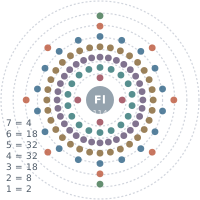
[Rn]7s2 7p2 5f14 6d10 (predicted)
Electrons are arranged in shells (principal energy levels) around the nucleus. The diagram is a schematic — orbitals in the same shell are not drawn separately.
About Flerovium
Flerovium is a synthetic chemical element; it has symbol Fl and atomic number 114. It is an extremely radioactive, superheavy element, named after the Flerov Laboratory of Nuclear Reactions of the Joint Institute for Nuclear Research in Dubna, Russia, where the element was discovered in 1999. The lab's name, in turn, honours Russian physicist Georgy Flyorov. IUPAC adopted the name on 30 May 2012. The name and symbol had previously been proposed for element 102 (nobelium) but were not accepted by IUPAC at that time.
Discovery & history
Discovered: 1999 · Joint Institute for Nuclear Research
In the late 1940s to early 1960s, the early days of making heavier and heavier transuranic elements, it was predicted that since such elements did not occur naturally, they would have shorter and shorter spontaneous fission half-lives, until they stopped existing altogether around element 108 (now called hassium). Initial work in synthesizing the heavier actinides seemed to confirm this. But the nuclear shell model, introduced in 1949 and extensively developed in the late 1960s by William Myers and Władysław Świątecki, stated that protons and neutrons form shells within a nucleus, analogous to electron shells. Noble gases are unreactive due to a full electron shell; similarly, it was theorized that elements with full nuclear shells – those having "magic" numbers of protons or neutrons – would be stabilized against decay. A doubly magic isotope, with magic numbers of both protons and neut
Isotopes
While the method of chemical characterization of a daughter was successful for flerovium and livermorium, and the simpler structure of even–even nuclei made confirmation of oganesson (Z = 118) straightforward, there have been difficulties in establishing the congruence of decay chains from isotopes with odd protons, odd neutrons, or both. To get around this problem with hot fusion, the decay chains from which terminate in spontaneous fission instead of connecting to known nuclei as cold fusion allows, experiments were done in Dubna in 2015 to produce lighter isotopes of flerovium by reaction of 48Ca with 239Pu and 240Pu, particularly 283Fl, 284Fl, and 285Fl; the last had previously been characterized in the 242Pu(48Ca,5n)285Fl reaction at Lawrence Berkeley National Laboratory in 2010. 285Fl was more clearly characterized, while the new isotope 284Fl was found to undergo immediate spontan
Advertisement
Frequently asked questions
What is the atomic number of Flerovium?
The atomic number of Flerovium is 114, which equals the number of protons in its nucleus.
What is the atomic mass of Flerovium?
The atomic mass of Flerovium is approximately 290.192 u (one twelfth of the mass of a carbon-12 atom).
What is the electron configuration of Flerovium?
The electron configuration of Flerovium is [Rn]7s2 7p2 5f14 6d10 (predicted).
Where is Flerovium in the periodic table?
Flerovium is located in period 7, group 14.
When was Flerovium discovered?
Flerovium was discovered in 1998.