Silicon (Si)
Metalloids · Solid · Period 3 · Group 14

Element Properties
- Atomic Number
- 14
- Symbol
- Si
- Atomic Mass
- 28.085
- Category
- Metalloids
- Standard State
- Solid
- Period
- 3
- Group
- 14
- Electronegativity
- 1.9
- Atomic Radius
- 210
- Ionization Energy
- 8.15
- Electron Affinity
- 1.39
- Oxidation States
- +4, +2, -4
- Melting Point
- 1687 K (1413.85 °C)
- Boiling Point
- 3538 K (3264.85 °C)
- Density
- 2.3296
- Electron Configuration
- [Ne]3s2 3p2
- Year Discovered
- 1854
Electron shells
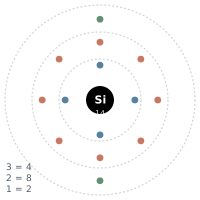
[Ne]3s2 3p2
Electrons are arranged in shells (principal energy levels) around the nucleus. The diagram is a schematic — orbitals in the same shell are not drawn separately.
About Silicon
Silicon is a chemical element; it has symbol Si and atomic number 14. It is a hard, brittle crystalline solid with a blue-grey metallic lustre, and is a tetravalent non-metal and semiconductor. It is a member of group 14 in the periodic table: carbon is above it; and germanium, tin, lead, and flerovium are below it. It is relatively unreactive. Silicon is a significant element that is essential for several physiological and metabolic processes in plants. Silicon is widely used as a semiconductor material in various electrical devices such as transistors, solar cells, and integrated circuits. It dominates semiconductor applications due to its low cost, excellent electronic properties, and adaptable physical characteristics.
Discovery & history
Discovered: 1823 · Jöns Jacob Berzelius
Owing to the abundance of silicon in the Earth's crust, natural silicon-based materials have been used for thousands of years. Silicon rock crystals were familiar to various ancient civilizations, such as the predynastic Egyptians who used them for beads and small vases, as well as the ancient Chinese. Glass containing silica was manufactured by the Egyptians since at least 1500 BC, as well as by the ancient Phoenicians. Natural silicate compounds were also used in various types of mortar for construction of early human dwellings.
Uses & applications
Crystalline bulk silicon is rather inert, but becomes more reactive at high temperatures. Like its neighbour aluminium, silicon forms a thin, continuous surface layer of silicon dioxide (SiO2) that protects the material beneath from oxidation. Because of this, silicon does not measurably react with the air below 900 °C. Between 950 °C and 1160 °C, the formation rate of the vitreous dioxide rapidly increases, and when 1400 °C is reached, atmospheric nitrogen also reacts to give the nitrides SiN and Si3N4. Silicon reacts with gaseous sulfur at 600 °C and gaseous phosphorus at 1000 °C. This oxide layer nevertheless does not prevent reaction with the halogens; fluorine attacks silicon vigorously at room temperature, chlorine does so at about 300 °C, and bromine and iodine at about 500 °C. Silicon does not react with most aqueous acids, but is oxidised and complexed by hydrofluoric acid mixtu
Isotopes
Naturally occurring silicon is composed of three stable isotopes, 28Si (92.24%), 29Si (4.67%), and 30Si (3.07%). Out of these, only the odd 29Si is of use in NMR and EPR spectroscopy, and it has nuclear spin (I =1/2). All three are produced in Type Ia supernovae through the oxygen-burning process, with 28Si being made as part of the alpha process and hence the most abundant. The fusion of 28Si with alpha particles by photodisintegration rearrangement in stars is known as the silicon-burning process; it is the last stage of stellar nucleosynthesis before the rapid collapse and violent explosion of the star in question in a type II supernova. Twenty-two radioisotopes have been characterized, the two stablest being 32Si with a half-life of about 157 years, and 31Si with a half-life of 2.62 hours. All the remaining radioactive isotopes have half-lives that are less than seven seconds, and
Advertisement
Frequently asked questions
What is the atomic number of Silicon?
The atomic number of Silicon is 14, which equals the number of protons in its nucleus.
What is the atomic mass of Silicon?
The atomic mass of Silicon is approximately 28.085 u (one twelfth of the mass of a carbon-12 atom).
What is the electron configuration of Silicon?
The electron configuration of Silicon is [Ne]3s2 3p2.
Where is Silicon in the periodic table?
Silicon is located in period 3, group 14.
When was Silicon discovered?
Silicon was discovered in 1854.