Roentgenium (Rg)
Transition Metals · Expected to be a solid · Period 7 · Group 11
Element Properties
- Atomic Number
- 111
- Symbol
- Rg
- Atomic Mass
- 282.169
- Category
- Transition Metals
- Standard State
- Expected to be a solid
- Period
- 7
- Group
- 11
- Electronegativity
- —
- Atomic Radius
- —
- Ionization Energy
- —
- Electron Affinity
- —
- Oxidation States
- 5, 3, 1, -1
- Melting Point
- —
- Boiling Point
- —
- Density
- —
- Electron Configuration
- [Rn]7s2 5f14 6d9 (predicted)
- Year Discovered
- 1994
Electron shells
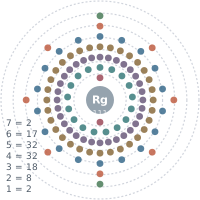
[Rn]7s2 5f14 6d9 (predicted)
Electrons are arranged in shells (principal energy levels) around the nucleus. The diagram is a schematic — orbitals in the same shell are not drawn separately.
About Roentgenium
Roentgenium is a synthetic chemical element; it has symbol Rg and atomic number 111. It is extremely radioactive and can only be created in a laboratory. The most stable known isotope, roentgenium-282, has a half-life of 130 seconds, although the unconfirmed roentgenium-286 may have a longer half-life of about 10.7 minutes. Roentgenium was first created in December 1994 by the GSI Helmholtz Centre for Heavy Ion Research near Darmstadt, Germany. It is named after the physicist Wilhelm Röntgen, who discovered X-rays. Only a few roentgenium atoms have ever been synthesized, and they have no practical application.
Discovery & history
Discovered: 1994 · GSI Helmholtz Centre for Heavy Ion Research
Roentgenium was first synthesized by an international team led by Sigurd Hofmann at the Gesellschaft für Schwerionenforschung (GSI) in Darmstadt, Germany, on December 8, 1994. The team bombarded a target of bismuth-209 with accelerated nuclei of nickel-64 and detected three nuclei of the isotope 272111:
Isotopes
Roentgenium has no stable or naturally occurring isotopes. Several radioactive isotopes have been synthesized in the laboratory, either by fusion of the nuclei of lighter elements or as intermediate decay products of heavier elements. Nine different isotopes of roentgenium have been reported with atomic masses 272, 274, 278–283, and 286 (283 and 286 unconfirmed), two of which, roentgenium-272 and roentgenium-274, have known but unconfirmed metastable states. All of these decay through alpha decay or spontaneous fission, though 280Rg may also have an electron capture branch.
Advertisement
Frequently asked questions
What is the atomic number of Roentgenium?
The atomic number of Roentgenium is 111, which equals the number of protons in its nucleus.
What is the atomic mass of Roentgenium?
The atomic mass of Roentgenium is approximately 282.169 u (one twelfth of the mass of a carbon-12 atom).
What is the electron configuration of Roentgenium?
The electron configuration of Roentgenium is [Rn]7s2 5f14 6d9 (predicted).
Where is Roentgenium in the periodic table?
Roentgenium is located in period 7, group 11.
When was Roentgenium discovered?
Roentgenium was discovered in 1994.