Nobelium (No)
Actinides · Solid · Period 7 · Group 3
Element Properties
- Atomic Number
- 102
- Symbol
- No
- Atomic Mass
- 259.101
- Category
- Actinides
- Standard State
- Solid
- Period
- 7
- Group
- 3
- Electronegativity
- 1.3
- Atomic Radius
- —
- Ionization Energy
- 6.65
- Electron Affinity
- —
- Oxidation States
- +3, +2
- Melting Point
- 1100 K (826.85 °C)
- Boiling Point
- —
- Density
- —
- Electron Configuration
- [Rn]7s2 5f14
- Year Discovered
- 1957
Electron shells
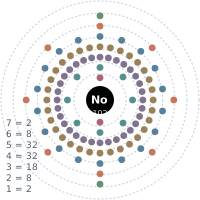
[Rn]7s2 5f14
Electrons are arranged in shells (principal energy levels) around the nucleus. The diagram is a schematic — orbitals in the same shell are not drawn separately.
About Nobelium
Nobelium is a synthetic chemical element; it has symbol No and atomic number 102. It is named after Alfred Nobel, the inventor of dynamite and benefactor of science. A radioactive metal, it is the tenth transuranium element, the second transfermium, and is the fourteenth member of the actinide series. Like all elements with atomic number over 100, nobelium can only be produced in particle accelerators by bombarding lighter elements with charged particles. A total of twelve nobelium isotopes are known to exist; the most stable is 259No with a half-life of 58 minutes, but the shorter-lived 255No is most commonly used in chemistry because it can be produced on a larger scale.
Discovery & history
Discovered: 1958 · Glenn Theodore Seaborg
The discovery of element 102 was a complicated process and was claimed by groups from Sweden, the United Kingdom, the United States, and the Soviet Union. The first complete and incontrovertible report of its detection only came in 1966 from the Joint Institute of Nuclear Research at Dubna (then in the Soviet Union). The first announcement of the discovery of element 102 was announced by physicists from Argonne National Laboratory, Harwell Atomic Energy Research Establishment, and Nobel Institute for Physics in Sweden in 1957. The team reported that they had bombarded a curium target with carbon-13 ions in half-hour intervals for fifty times. Between bombardments, ion-exchange chemistry was performed on the target. Twelve out of the fifty bombardments contained samples emitting (8.5 ± 0.1) MeV alpha particles, which were in drops which eluted earlier than fermium (atomic number Z = 100)
Isotopes
Fourteen isotopes of nobelium are known, with mass numbers 248–260 and 262; all are radioactive. Additionally, seventeen nuclear isomers are known, their mass numbers range between 250 to 256. Of these, the longest-lived isotope is 259No with a half-life of 58 minutes, and the longest-lived isomer is 251mNo with a half-life of 1.02 seconds. However, the still undiscovered isotope 261No is predicted to have a still longer half-life of 3 hours. Additionally, the shorter-lived 255No (half-life 3.52 minutes) is more often used in chemical experimentation because it can be produced in larger quantities from irradiation of californium-249 with carbon-12 ions. After 259No and 255No, the next most stable nobelium isotopes are 253No (half-life 1.57 minutes), 254No (51.2 seconds), 257No (24.5 seconds), 256No (2.91 seconds), and 252No (2.467 seconds). All of the remaining nobelium isotopes have hal
Advertisement
Frequently asked questions
What is the atomic number of Nobelium?
The atomic number of Nobelium is 102, which equals the number of protons in its nucleus.
What is the atomic mass of Nobelium?
The atomic mass of Nobelium is approximately 259.101 u (one twelfth of the mass of a carbon-12 atom).
What is the electron configuration of Nobelium?
The electron configuration of Nobelium is [Rn]7s2 5f14.
Where is Nobelium in the periodic table?
Nobelium is located in period 7, group 3.
When was Nobelium discovered?
Nobelium was discovered in 1957.