Mendelevium (Md)
Actinides · Solid · Period 7 · Group 3
Element Properties
- Atomic Number
- 101
- Symbol
- Md
- Atomic Mass
- 258.0984
- Category
- Actinides
- Standard State
- Solid
- Period
- 7
- Group
- 3
- Electronegativity
- 1.3
- Atomic Radius
- —
- Ionization Energy
- 6.58
- Electron Affinity
- —
- Oxidation States
- +3, +2
- Melting Point
- 1100 K (826.85 °C)
- Boiling Point
- —
- Density
- —
- Electron Configuration
- [Rn]7s2 5f13
- Year Discovered
- 1955
Electron shells
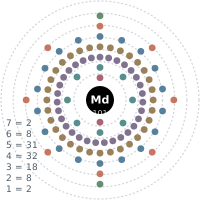
[Rn]7s2 5f13
Electrons are arranged in shells (principal energy levels) around the nucleus. The diagram is a schematic — orbitals in the same shell are not drawn separately.
About Mendelevium
Mendelevium is a synthetic chemical element; it has symbol Md and atomic number 101. A metallic radioactive transuranium element in the actinide series, it is the first element by atomic number that currently cannot be produced in macroscopic quantities by neutron bombardment of lighter elements. It is the thirteenth actinide, the ninth transuranic element, and the first transfermium; it is named after Dmitri Mendeleev, the father of the periodic table.
Discovery & history
Discovered: 1955 · Glenn Theodore Seaborg
Mendelevium was the ninth transuranic element to be synthesized. It was first synthesized by Albert Ghiorso, Glenn T. Seaborg, Gregory Robert Choppin, Bernard G. Harvey, and team leader Stanley G. Thompson in early 1955 at the University of California, Berkeley. The team produced 256Md (half-life 77.7 minutes) when they bombarded an 253Es target consisting of only a billion (109) einsteinium atoms with alpha particles (helium nuclei) in the Berkeley Radiation Laboratory's 60-inch cyclotron, thus increasing the target's atomic number by two. 256Md thus became the first isotope of any element to be synthesized one atom at a time. In total, seventeen mendelevium atoms were detected. This discovery was part of a program, begun in 1952, that irradiated plutonium with neutrons to transmute it into heavier actinides. This method was necessary because of a lack of known beta decaying isotopes of
Uses & applications
The lightest isotopes (244Md to 247Md) are mostly produced through bombardment of bismuth targets with argon ions, while slightly heavier ones (248Md to 253Md) are produced by bombarding plutonium and americium targets with ions of carbon and nitrogen. The most important and most stable isotopes are in the range from 254Md to 258Md and are produced through bombardment of einsteinium with alpha particles: einsteinium-253, −254, and −255 can all be used. 259Md is produced as a daughter of 259No, and 260Md can be produced in a transfer reaction between einsteinium-254 and oxygen-18. Typically, the most commonly used isotope 256Md is produced by bombarding either einsteinium-253 or −254 with alpha particles: einsteinium-254 is preferred when available because it has a longer half-life and therefore can be used as a target for longer. Using available microgram quantities of einsteinium, femto
Isotopes
Seventeen isotopes of mendelevium are known, with mass numbers from 244 to 260; all are radioactive. The longest-lived isotope is 258Md with a half-life of 51.6 days. Nevertheless, the shorter-lived 256Md (half-life 77.7 minutes) is more often used in chemical experiments because it can be produced in larger quantities from einsteinium, as 258Md would require 255Es, of which significant quantities are available only as a minor component of an isotopic mixture. The half-lives of mendelevium isotopes mostly increase smoothly (apart from odd/even effects) toward higher mass, up to 258Md, then decrease (as indicated by what experimental data is available) as spontaneous fission becomes the dominant decay mode; the second longest-living isotope is 260Md, the heaviest known, with a half-life of 27.8 days. Mendelevium is the last element that has any known isotope with a half-life longer than a
Advertisement
Frequently asked questions
What is the atomic number of Mendelevium?
The atomic number of Mendelevium is 101, which equals the number of protons in its nucleus.
What is the atomic mass of Mendelevium?
The atomic mass of Mendelevium is approximately 258.0984 u (one twelfth of the mass of a carbon-12 atom).
What is the electron configuration of Mendelevium?
The electron configuration of Mendelevium is [Rn]7s2 5f13.
Where is Mendelevium in the periodic table?
Mendelevium is located in period 7, group 3.
When was Mendelevium discovered?
Mendelevium was discovered in 1955.