비소 (As)
준금속 · 고체 · 주기 4 · 족 15

원소 성질
- 원자 번호
- 33
- 상징
- As
- 원자량
- 74.9216
- 카테고리
- 준금속
- 표준 상태
- 고체
- 주기
- 4
- 족
- 15
- 전기력
- 2.18
- 원자 반지름
- 185
- 이온화 에너지
- 9.81
- 전자친화력
- 0.81
- 산화 상태
- +5, +3, -3
- 녹이는점
- 1090 K (816.85 °C)
- 응고점
- 887 K (613.85 °C)
- 밀도
- 5.776
- 전자 구조
- [Ar]4s2 3d10 4p3
- 발견 연도
- 고대
전자殻
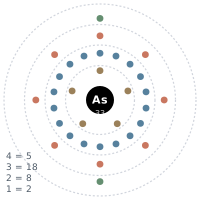
[Ar]4s2 3d10 4p3
전자는 핵 주위의殻(주요 에너지 수준)에 배열됩니다. 도표는 설계도입니다 — 같은殻의 오르비털은 별도로 그려지지 않습니다.
비소에 대해
비소(砒素←일본어: ヒ素 히소[*], 영어: Arsenic아서닉[*])는 화학 원소로 기호는As(←라틴어: Arsenicum아르세니쿰[*])이고 원자 번호는33이다. 독성으로 유명한 준금속 원소로 회색, 황색, 흑색의 세 가지 동소체로 존재한다. 농약·제초제·살충제 등의 재료이며, 여러 합금에도 사용된다.
발견 과정
발견: 1300 · Albertus Magnus
The word arsenic has its origin in the Syriac word ܙܪܢܝܟܐ zarnika, from Arabic al-zarnīḵ الزرنيخ 'the orpiment', based on Persian zar ("gold") from the word زرنيخ zarnikh, meaning "yellow" (literally "gold-colored") and hence "(yellow) orpiment". It was adopted into Greek (using folk etymology) as arsenikon (ἀρσενικόν) – a neuter form of the Greek adjective arsenikos (ἀρσενικός), meaning "male", "virile". Latin-speakers adopted the Greek term as arsenicum, which in French ultimately became arsenic, whence the English word "arsenic". Arsenic sulfides (orpiment, realgar) and oxides have been known and used since ancient times. Zosimos (c. 300 AD) describes roasting sandarach (realgar) to obtain cloud of arsenic (arsenic trioxide), which he then reduces to gray arsenic. As the symptoms of arsenic poisoning are not very specific, the substance was frequently used for murder until the advent
용도와 활용
Compounds of arsenic resemble, in some respects, those of phosphorus, which occupies the same group (column) of the periodic table. The most common oxidation states for arsenic are: −3 in the arsenides, which are alloy-like intermetallic compounds, +3 in the arsenites, and +5 in the arsenates and most organoarsenic compounds. Arsenic also bonds readily to itself as seen in the square As43− ions in the mineral skutterudite. In the +3 oxidation state, arsenic is typically pyramidal owing to the influence of the lone pair of electrons.
동위원소
Arsenic occurs naturally as a single stable isotope, 75As. Synthetic radioisotopes are known from 64As to 95As, as well as at least 11 isomers. The most stable of these are 73As with a half-life of 80.30 days and 74As with a half-life of 17.77 days, followed by 71As (65.30 hours), 77As (38.79 hours), 76As (26.24 hours), and 72As (26.0 hours). All others have half-lives under 100 minutes and most under one minute. Isotopes lighter than the stable one generally decay by positron emission or electron capture to germanium isotopes, while those heavier beta decay to selenium isotopes. A notable exception is that 74As decays both ways.
광고
자주 묻는 질문
비소의 원자번호는 얼마입니까?
비소의 원자번호는 33이며, 원자핵 속 양성자 수와 같습니다.
비소의 원자량은 얼마입니까?
비소의 원자량은 약 74.9216 u입니다(탄소-12 원자량의 12분의 1 기준).
비소의 전자 배치는 어떻게 됩니까?
비소의 전자 배치는 [Ar]4s2 3d10 4p3입니다.
비소는 주기표의 어디에 있습니까?
비소는 제4주기, 제15족에 위치합니다.
비소는 언제 발견되었습니까?
비소는 인류가 아주 오래전부터 알고 있었습니다.