타이타늄 (Ti)
천이 금속 · 고체 · 주기 4 · 족 4

원소 성질
- 원자 번호
- 22
- 상징
- Ti
- 원자량
- 47.867
- 카테고리
- 천이 금속
- 표준 상태
- 고체
- 주기
- 4
- 족
- 4
- 전기력
- 1.54
- 원자 반지름
- 187
- 이온화 에너지
- 6.83
- 전자친화력
- 0.08
- 산화 상태
- +4, +3, +2
- 녹이는점
- 1941 K (1667.85 °C)
- 응고점
- 3560 K (3286.85 °C)
- 밀도
- 4.5
- 전자 구조
- [Ar]4s2 3d2
- 발견 연도
- 1791
전자殻
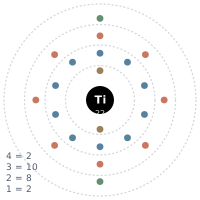
[Ar]4s2 3d2
전자는 핵 주위의殻(주요 에너지 수준)에 배열됩니다. 도표는 설계도입니다 — 같은殻의 오르비털은 별도로 그려지지 않습니다.
타이타늄에 대해
타이타늄,(←영어: Titanium타이테이니엄[*]) 또는 티탄(←독일어: Titan티탄[*],일본어: チタン 치탄[*])은 화학 원소로 기호는Ti(←라틴어: Titanium티타니움[*])이고 원자 번호는22이다. 가볍고 단단하며, 거의 부식되지 않는다. 전이 금속 원소로 은백색의 금속 광택이 있으며, 순수한 타이타늄은 낮은 물성치로 인해 강한 내식성이 요구되는 곳을 제외하고 대부분 합금으로 많이 쓰인다. 또한 이산화 타이타늄은 흰색 안료의 재료로, 페인트 등에 쓰인다. 타이타늄은 여러 광물에 널리 분포하는데, 주로 티탄철석과 금홍석에서 얻는다. 두 가지 동소체와 다섯 가지 자연 동위 원소로 발견되며, 가장 흔한 것은48Ti이다. 타이타늄의 가장 중요한 성질은 뛰어난 내식성과 비중이 낮아 강철 대비 무게는60% 밖에 되지 않는다는 것이다. 타이타늄의 물리적, 화학적 성질은 지르코늄과 비슷하다.
발견 과정
발견: 1791 · William Gregor
1791년 영국 아마추어 지질학자이자 목사인William Gregor는 강가의 하천에서 타이타늄을 발견하고 ‘Manaccanite’로 명명하였다. 1795년 독일의Martin H. Klaproth가Rutile(금홍석)에서 타이타늄을 따로 추출해 ‘Titan’으로 명명하였다. 1797년 두 사람이 발견한 원소가 동일한 것으로 밝혀졌으며 영국에서는 ‘Titanium’ 독일에서는 ‘Titan’ 이라고 표기한다.
용도와 활용
Titanium is the ninth-most abundant element in Earth's crust (0.63% by mass) and the seventh-most abundant metal. It is present as oxides in most igneous rocks, in sediments derived from them, in living things, and natural bodies of water. Of the 801 types of igneous rocks analyzed by the United States Geological Survey, 784 contained titanium. Its proportion in soils is approximately 0.5–1.5%. Common titanium-containing minerals are anatase, brookite, ilmenite, perovskite, rutile, and titanite (sphene). Akaogiite is an extremely rare mineral consisting of titanium dioxide. Of these minerals, only rutile and ilmenite have economic importance, yet even they are difficult to find in high concentrations. About 6.0 and 0.7 million tonnes of those minerals were mined in 2011, respectively. Significant titanium-bearing ilmenite deposits exist in Australia, Canada, China, India, Mozambique, New
동위원소
Naturally occurring titanium is composed of five stable isotopes: 46Ti, 47Ti, 48Ti, 49Ti, and 50Ti, with 48Ti being the most abundant (73.8% natural abundance). Twenty-three radioisotopes have been characterized, the most stable of which are 44Ti with a half-life of 63 years; 45Ti, 184.8 minutes; 51Ti, 5.76 minutes; and 52Ti, 1.7 minutes. All other radioactive isotopes have half-lives less than 33 seconds, with the majority less than half a second. The isotopes of titanium range from 39Ti to 66Ti. The primary decay mode for isotopes lighter than 46Ti is positron emission (with the exception of 44Ti, which undergoes electron capture), leading to isotopes of scandium, and the primary mode for isotopes heavier than 50Ti is beta emission, leading to isotopes of vanadium. Titanium becomes radioactive upon bombardment with deuterons, emitting mainly positrons and hard gamma rays.
광고
자주 묻는 질문
타이타늄의 원자번호는 얼마입니까?
타이타늄의 원자번호는 22이며, 원자핵 속 양성자 수와 같습니다.
타이타늄의 원자량은 얼마입니까?
타이타늄의 원자량은 약 47.867 u입니다(탄소-12 원자량의 12분의 1 기준).
타이타늄의 전자 배치는 어떻게 됩니까?
타이타늄의 전자 배치는 [Ar]4s2 3d2입니다.
타이타늄는 주기표의 어디에 있습니까?
타이타늄는 제4주기, 제4족에 위치합니다.
타이타늄는 언제 발견되었습니까?
타이타늄는 1791년에 발견되었습니다.