칼륨 (K)
알칼리 금속 · 고체 · 주기 4 · 족 1

원소 성질
- 원자 번호
- 19
- 상징
- K
- 원자량
- 39.0983
- 카테고리
- 알칼리 금속
- 표준 상태
- 고체
- 주기
- 4
- 족
- 1
- 전기력
- 0.82
- 원자 반지름
- 275
- 이온화 에너지
- 4.34
- 전자친화력
- 0.5
- 산화 상태
- +1
- 녹이는점
- 336.53 K (63.38 °C)
- 응고점
- 1032 K (758.85 °C)
- 밀도
- 0.89
- 전자 구조
- [Ar]4s1
- 발견 연도
- 1807
전자殻
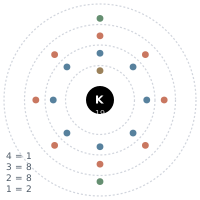
[Ar]4s1
전자는 핵 주위의殻(주요 에너지 수준)에 배열됩니다. 도표는 설계도입니다 — 같은殻의 오르비털은 별도로 그려지지 않습니다.
칼륨에 대해
칼륨(문화어: 칼리움←독일어: Kalium칼리움[*], 일본어: カリウム 카리우무[*]) 또는 포타슘(영어: Potassium포태슘(puh·tae·see·uhm)[*] [pətæsiəm]), 칼리(문화어: 카리←라틴어: Kali칼리[*])는 알칼리 금속에 속하는1족 화학 원소로 기호는K(←라틴어: Kalium칼리움[*])이고 원자 번호는19이다. 무른 은백색 금속으로 바닷물이나 다른 광물에 주로 화합물의 형태로 널리 분포한다. 공기나 물 속에서 급격히 반응하여 산화하며, 나트륨과 화학적 성질이 비슷하다. 2000년 대한화학회에서 공식 명칭을IUPAC명칭인 포타슘으로 개정하되, 당분간은 칼륨도 혼용할 수 있다고 정했다. 대한화학회에서는2014년부터 포타슘 단독 표기로 방침을 바꿨다. 현재의 국립국어원 지정 표준어는 칼륨이다. 1가 양이온 칼륨(K+)이 포함된 염 즉, 질산 칼륨(KNO2), 염화 칼륨(KCl), 황화 칼륨(K2S), 황산 칼륨(K2SO4), 탄산 칼륨(K2CO3)은 물에 잘 녹는다.
발견 과정
발견: 1807 · Humphry Davy
Potassium metal was first isolated in 1807 by Humphry Davy, who derived it by electrolysis of molten caustic potash (KOH) with the newly discovered voltaic pile. Potassium was the first metal that was isolated by electrolysis. Later in the same year, Davy reported extraction of the metal sodium from a mineral derivative (caustic soda, NaOH, or lye) rather than a plant salt, by a similar technique, demonstrating that the elements, and thus the salts, are different. Although the production of potassium and sodium metal should have shown that both are elements, it took some time before this view was universally accepted.
용도와 활용
Reflecting its low first ionization energy of 418.8 kJ/mol, potassium is a strong reducing agent, i.e., it readily releases an electron upon contact with other materials. With graphite, potassium metal forms graphite intercalation compounds. One such compound has the formula KC8, a gold colored solid that is described as a K+ salt of negatively charged graphite. Potassium can reduce many salts to the metal as illustrated by the Rieke method for making magnesium powder from magnesium chloride:
동위원소
There are 25 known isotopes of potassium, three of which occur naturally: 39K (93.3%), 40K (0.0117%), and 41K (6.7%) (by mole fraction). Naturally occurring 40K has a half-life of 1.250×10⁹ years. It decays to stable 40Ar by electron capture or positron emission (11.2%) or to stable 40Ca by beta decay (88.8%). This decay results in a relatively higher concentration of Argon in the atmosphere. The decay of 40K to 40Ar is the basis of a common method for dating rocks. The conventional potassium–argon dating method depends on the assumption that the rocks contained no argon at the time of formation and that all the subsequent radiogenic argon (40Ar) was quantitatively retained. Minerals are dated by measurement of the concentration of potassium and the amount of radiogenic 40Ar that has accumulated. The minerals best suited for dating include biotite, muscovite, metamorphic hornblende, and
광고
자주 묻는 질문
칼륨의 원자번호는 얼마입니까?
칼륨의 원자번호는 19이며, 원자핵 속 양성자 수와 같습니다.
칼륨의 원자량은 얼마입니까?
칼륨의 원자량은 약 39.0983 u입니다(탄소-12 원자량의 12분의 1 기준).
칼륨의 전자 배치는 어떻게 됩니까?
칼륨의 전자 배치는 [Ar]4s1입니다.
칼륨는 주기표의 어디에 있습니까?
칼륨는 제4주기, 제1족에 위치합니다.
칼륨는 언제 발견되었습니까?
칼륨는 1807년에 발견되었습니다.