마그네슘 (Mg)
알칼리 토금속 · 고체 · 주기 3 · 족 2

원소 성질
- 원자 번호
- 12
- 상징
- Mg
- 원자량
- 24.305
- 카테고리
- 알칼리 토금속
- 표준 상태
- 고체
- 주기
- 3
- 족
- 2
- 전기력
- 1.31
- 원자 반지름
- 173
- 이온화 에너지
- 7.65
- 전자친화력
- —
- 산화 상태
- +2
- 녹이는점
- 923 K (649.85 °C)
- 응고점
- 1363 K (1089.85 °C)
- 밀도
- 1.74
- 전자 구조
- [Ne]3s2
- 발견 연도
- 1808
전자殻
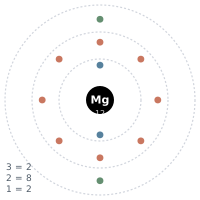
[Ne]3s2
전자는 핵 주위의殻(주요 에너지 수준)에 배열됩니다. 도표는 설계도입니다 — 같은殻의 오르비털은 별도로 그려지지 않습니다.
마그네슘에 대해
마그네슘(영어: Magnesium매그니지엄[*], 문화어: 마그네시움←독일어: Magnesium마그네지움[*], 일본어: マグネシウム 마구네시우무[*],한자:鎂)은 알칼리 토금속에 속하는 화학 원소로 기호는Mg(←라틴어: Magnesium마그네시움[*])이고 원자 번호는12이다. 실온에서 은백색의 가벼운 금속으로 존재한다. 반응성이 크고2가 양이온이 되려는 경향이 있으므로 자연에서는 주로 마그네사이트, 백운암, 활석, 석면 등의 화합물의 형태로 발견된다. 지구의 지각에서는 질량 기준으로 약2.5%를 차지하여8번째로 많이 존재하는 원소이며, 우주 전체에서도8번째로 많이 존재하는 원소이다. 우주에 있는 마그네슘은 주로3개의 헬륨 원자핵과1개의 탄소 원자핵이 크고 오래된 별 안에서 핵융합을 함으로써 생성되었다. 해수에는 이온(Mg2+)의 형태로 존재하며, 해수 속 이온 중에서는 염화 이온(Cl-), 나트륨 이온(Na+) 이어 세 번째로 많은 양이다. 주로 해수에서 얻은 염화 마그네슘(MgCl2)을 전기분해하여 얻거나 마그네사이트, 백운암 등의 광물에서 얻는다. 인체 내에서는11번째로 많이 존재하는 원소이며, 300여가지 효소들과 모든 세포에게 필수적인 원소이다. 마그네슘은 세포 내에서 인산기를 가지는DNA, RNA, ATP등의 물질을 생성하고 수백가지의 효소들이 작용하는 데 관여한다. 또한 탄수화물 대사 과정에서 촉매로 작용하므로 생명 활동에 중요한 역할을 한다. 식물의 엽록소에도 마그네슘 이온이 포함되어 있어 광합성에 중요한 역할을 한다. 마그네슘 화합물들은 의학적으로 변비약, 제산제(예시: 마그네시아 유제, m
발견 과정
발견: 1755 · Joseph Black
The name magnesium originates from the Greek word for locations related to the tribe of the Magnetes, either a district in Thessaly called Magnesia or Magnesia ad Sipylum, now in Turkey. It is related to magnetite and manganese, which also originated from this area, and required differentiation as separate substances. See the manganese article for this history. In 1618, a farmer at Epsom in England attempted to give his cows water from a local well. The cows refused to drink because of the water's bitter taste, but the farmer noticed that the water seemed to heal scratches and rashes. The substance obtained by evaporating the water became known as Epsom salts and its fame spread. It was eventually recognized as hydrated magnesium sulfate, MgSO4·7 H2O. The metal itself was first isolated by Sir Humphry Davy in England in 1808. He used electrolysis on a mixture of magnesia and mercuric oxi
용도와 활용
마그네슘은 철보다 반응성이 크므로 지하에 매설된 각종 철제 구조물이 녹슬지 않도록 하는 희생 금속으로 사용된다. 우라늄이나 다른 금속의 염에서 금속을 얻을 때 환원제로 사용된다.
동위원소
Magnesium has three stable isotopes: 24Mg, 25Mg and 26Mg. All are present in significant amounts in nature (see table of isotopes above). About 79% of Mg is 24Mg. The isotope 28Mg is radioactive and in the 1950s to 1970s was produced by several nuclear power plants for use in scientific experiments. This isotope has a relatively short half-life (21 hours) and its use was limited by shipping times. The nuclide 26Mg has found application in isotopic geology, similar to that of aluminium. 26Mg is a radiogenic daughter product of 26Al, which has a half-life of 717,000 years. Excessive quantities of stable 26Mg have been observed in the Ca-Al-rich inclusions of some carbonaceous chondrite meteorites. This anomalous abundance is attributed to the decay of its parent 26Al in the inclusions, and researchers conclude that such meteorites were formed in the solar nebula before the 26Al had decayed
광고
자주 묻는 질문
마그네슘의 원자번호는 얼마입니까?
마그네슘의 원자번호는 12이며, 원자핵 속 양성자 수와 같습니다.
마그네슘의 원자량은 얼마입니까?
마그네슘의 원자량은 약 24.305 u입니다(탄소-12 원자량의 12분의 1 기준).
마그네슘의 전자 배치는 어떻게 됩니까?
마그네슘의 전자 배치는 [Ne]3s2입니다.
마그네슘는 주기표의 어디에 있습니까?
마그네슘는 제3주기, 제2족에 위치합니다.
마그네슘는 언제 발견되었습니까?
마그네슘는 1808년에 발견되었습니다.