바륨 (Ba)
알칼리 토금속 · 고체 · 주기 6 · 족 2

원소 성질
- 원자 번호
- 56
- 상징
- Ba
- 원자량
- 137.33
- 카테고리
- 알칼리 토금속
- 표준 상태
- 고체
- 주기
- 6
- 족
- 2
- 전기력
- 0.89
- 원자 반지름
- 268
- 이온화 에너지
- 5.21
- 전자친화력
- —
- 산화 상태
- +2
- 녹이는점
- 1000 K (726.85 °C)
- 응고점
- 2170 K (1896.85 °C)
- 밀도
- 3.62
- 전자 구조
- [Xe]6s2
- 발견 연도
- 1808
전자殻
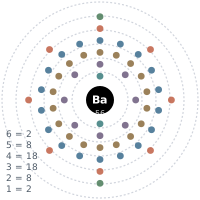
[Xe]6s2
전자는 핵 주위의殻(주요 에너지 수준)에 배열됩니다. 도표는 설계도입니다 — 같은殻의 오르비털은 별도로 그려지지 않습니다.
바륨에 대해
바륨(←영어: Barium베어리엄[*], 문화어: 바리움←독일어: Barium바리움[*])은 화학 원소로 기호는Ba(←라틴어: Barium바리움[*]), 원자 번호는56이다. 무른 은색의 금속 원소로, 알칼리 토금속에 속하며 녹는점이 매우 높다. 바륨은 산화물 또는 황산염 상태로 중정석 광물에서 산출된다. 그러나 공기와의 높은 반응성 때문에 순수한 금속으로는 산출되지 않는다. 바륨 화합물은 페인트나 유리 제조에 소량이 사용되며, 이들 중 물 또는 산에 녹지 않는 바륨 화합물인 황산 바륨은X선의 조영제로 사용되기도 한다. 바륨 이온은 독성이 있으므로 수용성 바륨염 및 위산과 반응할 수 있는 탄산 바륨 등은 조영제로 사용할 수 없다. 바륨 이온(Ba2+)의 화합물 중 질산 바륨(Ba(NO3)2), 수산화 바륨(Ba(OH)2), 염화 바륨(BaCl2), 황화 바륨(BaS)은 물에 잘 녹고, 황산 바륨(BaSO4), 탄산 바륨(BaCO3)은 물에 잘 녹지 않는다. 앙금 생성 반응을 통해 산출되는 황산 바륨, 탄산 바륨은 모두 흰색 앙금이다. 따라서, 바륨 이온 (Ba2+)을 검출할 때, 이러한 앙금이 유용하다. (→ 염 참조)
발견 과정
발견: 1808 · Carl Wilhelm Scheele
Alchemists in the early Middle Ages knew about some barium minerals. Smooth pebble-like stones of mineral baryte were found in volcanic rock near Bologna, Italy, and so were called "Bologna stones". Alchemists were attracted to them because after exposure to light they would glow for years. The phosphorescent properties of baryte heated with organics were described by V. Casciorolus in 1602. Carl Scheele determined that baryte contained a new element in 1772, but could not isolate barium, only barium oxide. Johan Gottlieb Gahn also isolated barium oxide two years later in similar studies. Oxidized barium was at first called "barote" by Guyton de Morveau, a name that was changed by Antoine Lavoisier to baryte (in French) or baryta (in Latin). Also in the 18th century, English mineralogist William Withering noted a heavy mineral in the lead mines of Cumberland, now known to be witherite. B
용도와 활용
Barium salts are typically white when solid and colorless when dissolved. They are denser than the strontium or calcium analogs (see table; zinc is given for comparison). Barium hydroxide ("baryta") was known to alchemists, who produced it by heating barium carbonate. Unlike calcium hydroxide, it absorbs very little CO2 in aqueous solutions and is therefore insensitive to atmospheric fluctuations. This property is used in calibrating pH equipment. Barium compounds burn with a green to pale green flame, which is an efficient test to detect a barium compound. The color results from spectral lines at 455.4, 493.4, 553.6, and 611.1 nm.
동위원소
All nuclear data not otherwise stated is from the standard source: Barium found in the Earth's crust is a mixture of seven primordial nuclides, barium-130, 132, and 134 through 138. Barium-130 undergoes very slow radioactive decay to xenon-130 by double beta plus decay, with a half-life of (0.5–2.7)×1021 years (about 1011 times the age of the universe). Its abundance is about 0.11% that of natural barium. Though barium-132 can theoretically undergo the same decay, giving xenon-132, experimental evidence has not detected this. Of the stable isotopes, barium-138 composes 71.7% of all barium; other isotopes have decreasing abundance with decreasing mass number (except for a probable inversion for the p-nuclei 130Ba and 132Ba). In total, barium has 41 known isotopes, ranging in mass between 114 and 154. The most stable artificial radioisotope is barium-133 with a half-life of 10.538 years. F
광고
자주 묻는 질문
바륨의 원자번호는 얼마입니까?
바륨의 원자번호는 56이며, 원자핵 속 양성자 수와 같습니다.
바륨의 원자량은 얼마입니까?
바륨의 원자량은 약 137.33 u입니다(탄소-12 원자량의 12분의 1 기준).
바륨의 전자 배치는 어떻게 됩니까?
바륨의 전자 배치는 [Xe]6s2입니다.
바륨는 주기표의 어디에 있습니까?
바륨는 제6주기, 제2족에 위치합니다.
바륨는 언제 발견되었습니까?
바륨는 1808년에 발견되었습니다.