황 (S)
반응성 비금속 · 고체 · 주기 3 · 족 16

원소 성질
- 원자 번호
- 16
- 상징
- S
- 원자량
- 32.07
- 카테고리
- 반응성 비금속
- 표준 상태
- 고체
- 주기
- 3
- 족
- 16
- 전기력
- 2.58
- 원자 반지름
- 180
- 이온화 에너지
- 10.36
- 전자친화력
- 2.08
- 산화 상태
- +6, +4, -2
- 녹이는점
- 388.36 K (115.21 °C)
- 응고점
- 717.75 K (444.6 °C)
- 밀도
- 2.067
- 전자 구조
- [Ne]3s2 3p4
- 발견 연도
- 고대
전자殻
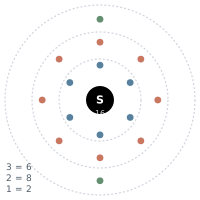
[Ne]3s2 3p4
전자는 핵 주위의殻(주요 에너지 수준)에 배열됩니다. 도표는 설계도입니다 — 같은殻의 오르비털은 별도로 그려지지 않습니다.
황에 대해
황(黃, sulfur) 또는 유황(硫黃←일본어: 硫黄 이오우[*], 문화어: 류황), 석유황(石硫黃, 문화어: 석류황)은 화학 원소의 하나이다. 기호는S(←라틴어: Sulphur술푸르[*]), 영문: 미:Sulfur, 영:Sulphur, Brimstone이고 원자 번호는16이다. 맛과 냄새가 없는 비금속 원소이다. 자연 상태에서는 순수한 황, 또는 황화물이나 황산염의 형태로 존재한다. 생명에 필수적인 원소로 두 종류의 아미노산에 황이 포함되어 있다. 비료의 주성분이며, 그밖에 화약, 성냥, 살충제, 살균제 등에도 쓰인다. 앙금 생성 반응을 통해 산출되는 황산 칼슘, 황산 바륨, 황산 납, 황산 은 등은 흰색 앙금이며, 산에 안정하다. 따라서, 황산 이온 (SO42-)을 검출할 때, 이러한 앙금이 유용하다. 또한 황화 이온(S2-)을 이용하여 검은 색의 황화 철, 황화 구리나 황화 납, 노란색의 황화 카드뮴 앙금을 통해, 용액 속에 철 이온, 구리 이온, 납 이온이나 카드뮴 이온이 들어 있는지 확인할 수 있다.
발견 과정
발견: 1777 · Antoine Lavoisier
According to the Ebers Papyrus, a sulfur ointment was used in ancient Egypt to treat granular eyelids. There are ancient Egyptian necklaces, dated between the Ptolemaic period and the early Roman period, with beads made of sulfur, shaped like flowers and cow heads. Sulfur is one of the ingredients of niello, a dark material used to decorate metallic items. Pliny the Elder mentioned, in the first century AD, that the Romans used a type of niello inherited from the Egyptians, who, according to him, made a dark pigment to depict Anubis on silver vessels. He lists a recipe where copper and silver are mixed with sulfur and heated to produce this material. In Roman jewelry, sulfur was used as a filler in hollow gold items, especially in gold rings. This practice was widespread enough to be included by Artemidorus in the section of the Oneirocritica about gold finger-rings, where he mentions ri
용도와 활용
황은 다원자 분자 물질아니고서 화학적 구조가 다른 형태로 존재하는 경우가 많다. 가장 잘 알려져 있으면서 가장 많은 구조는 사이클로-옥타 황(cyclo-S8)이다. cyclo-S8의 점군은D4d이고, 이 물질의 쌍극자 모멘트는0 D이다. 옥타 황은 부드럽고, 밝은 노란색을 띠는 고체이며 유독성 악취를 뿜어낸다. 이는 성냥과 비슷하다. 황의 녹는점은115.21 °C (239.38 °F)이며, 끓는점은444.6 °C (832.3 °F)이다. 또한 쉽게 승화하기도 한다. 95.2 °C (203.4 °F)에서 녹는점인115.21 °C (239.38 °F) 사이에서는 사이클로-옥타 황의 구조가 "α-옥타 황"에서 "β-옥타 황"으로 동질 이상화하여 다른 구조로 변한다. 다만S8의 고리형 구조는 사실상 변하지 않고, 분자 간 상호 작용에 영향을 미친다. 황의 녹는점과 끓는점 사이에서는 옥타 황이 다시 그 구조를 바꾸는데, 이때 "β-옥타 황"에서 "γ-황"으로 구조가 변한다. 이 과정에서의 황은 밀도가 낮아지지만, 중합체의 형성으로 인해 점도가 높아진다.그러나 이보다 더 높은 온도에서는, 해중합 반응으로 인해 점도가 낮아진다. 녹은 황은200 °C (392 °F) 이상에서는 어두운 붉은색을 띈다. 동소체에 따라 다르지만 황의 밀도는 대략2 g·cm-3이며, 모든 안정 동위 원소는 훌륭한 절연체이다.
동위원소
Sulfur has 23 known isotopes, four of which are stable: 32S (94.99%±0.26%), 33S (0.75%±0.02%), 34S (4.25%±0.24%), and 36S (0.01%±0.01%). Other than 35S, with a half-life of 87.37 days, the radioactive isotopes of sulfur have half-lives less than 3 hours. The preponderance of 32S is explained by its production in the alpha process (one of the main classes of nuclear fusion reactions) in exploding stars. Other stable sulfur isotopes are produced in the bypass processes related with 34Ar , and their composition depends on the type of a stellar explosion. For example, proportionally more 33S comes from novae than from supernovae. It has been found that the proportion of the two most abundant sulfur isotopes 32S and 34S varies in different samples by a surprisingly large amount. Determination of the isotope ratio (δ34S) in the samples indicates their chemical history, and with support of othe
광고
자주 묻는 질문
황의 원자번호는 얼마입니까?
황의 원자번호는 16이며, 원자핵 속 양성자 수와 같습니다.
황의 원자량은 얼마입니까?
황의 원자량은 약 32.07 u입니다(탄소-12 원자량의 12분의 1 기준).
황의 전자 배치는 어떻게 됩니까?
황의 전자 배치는 [Ne]3s2 3p4입니다.
황는 주기표의 어디에 있습니까?
황는 제3주기, 제16족에 위치합니다.
황는 언제 발견되었습니까?
황는 인류가 아주 오래전부터 알고 있었습니다.