Dysprosium (Dy)
Lanthanides · Solid · Period 6 · Group 3

Element Properties
- Atomic Number
- 66
- Symbol
- Dy
- Atomic Mass
- 162.5
- Category
- Lanthanides
- Standard State
- Solid
- Period
- 6
- Group
- 3
- Electronegativity
- 1.22
- Atomic Radius
- 229
- Ionization Energy
- 5.94
- Electron Affinity
- —
- Oxidation States
- +3
- Melting Point
- 1685 K (1411.85 °C)
- Boiling Point
- 2840 K (2566.85 °C)
- Density
- 8.55
- Electron Configuration
- [Xe]6s2 4f10
- Year Discovered
- 1886
Electron shells
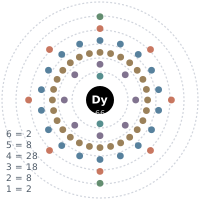
[Xe]6s2 4f10
Electrons are arranged in shells (principal energy levels) around the nucleus. The diagram is a schematic — orbitals in the same shell are not drawn separately.
About Dysprosium
Dysprosium is a chemical element; it has symbol Dy and atomic number 66. It is a rare-earth element in the lanthanide series with a metallic silver luster. Dysprosium is never found in nature as a free element, though, like other lanthanides, it is found in various minerals, such as xenotime. Naturally occurring dysprosium is composed of seven isotopes, the most abundant of which is 164Dy.
Discovery & history
Discovered: 1886 · Paul-Émile Lecoq de Boisbaudran
In 1878, erbium ores were found to contain the oxides of holmium and thulium. French chemist Paul Émile Lecoq de Boisbaudran, while working with holmium oxide, separated dysprosium oxide from it in Paris in 1886. His procedure for isolating the dysprosium involved dissolving dysprosium oxide in acid, then adding ammonia to precipitate the hydroxide. He was only able to isolate dysprosium from its oxide after more than 30 attempts at his procedure. On succeeding, he named the element dysprosium from the Greek dysprositos (δυσπρόσιτος), meaning "hard to get". The element was not isolated in relatively pure form until after the development of ion exchange techniques by Frank Spedding at Iowa State University in the early 1950s. Due to its role in permanent magnets used for wind turbines, it has been argued that dysprosium will be one of the main objects of geopolitical competition in a worl
Uses & applications
Dysprosium halides, such as DyF3 and DyBr3, tend to take on a yellow color. Dysprosium oxide, also known as dysprosia, is a white powder that is highly magnetic, more so than iron oxide. Dysprosium combines with various non-metals at high temperatures to form binary compounds with varying composition and oxidation states +3 and sometimes +2, such as DyN, DyP, DyH2 and DyH3; DyS, DyS2, Dy2S3 and Dy5S7; DyB2, DyB4, DyB6 and DyB12, as well as Dy3C and Dy2C3. Dysprosium carbonate, Dy2(CO3)3, and dysprosium sulfate, Dy2(SO4)3, result from similar reactions. Most dysprosium compounds are soluble in water, though dysprosium carbonate tetrahydrate (Dy2(CO3)3·4H2O) and dysprosium oxalate decahydrate (Dy2(C2O4)3·10H2O) are both insoluble in water. Two of the most abundant dysprosium carbonates, Dy2(CO3)3·2-3H2O (similar to the mineral tengerite-(Y)), and DyCO3(OH) (similar to minerals kozoite-(La)
Isotopes
Naturally occurring dysprosium is composed of seven isotopes: 156Dy, 158Dy, 160Dy, 161Dy, 162Dy, 163Dy, and 164Dy. These are all considered stable, although only the last two are theoretically stable: the others can theoretically undergo alpha decay. Of the naturally occurring isotopes, 164Dy is the most abundant at 28%, followed by 162Dy at 26%; the rarest is 156Dy at 0.06%. Dysprosium is the heaviest element to have isotopes that are theoretically stable rather than only observationally stable isotopes that are predicted to be radioactive. Twenty-nine radioisotopes have been synthesized, ranging in atomic mass from 138 to 173. The most stable of these is 154Dy, with a half-life of 1.40×10⁶ years, followed by 159Dy with a half-life of 144.4 days. As a general rule, isotopes that are lighter than the stable isotopes tend to decay primarily by β+ decay, though 154Dy decays by alpha emissi
Advertisement
Frequently asked questions
What is the atomic number of Dysprosium?
The atomic number of Dysprosium is 66, which equals the number of protons in its nucleus.
What is the atomic mass of Dysprosium?
The atomic mass of Dysprosium is approximately 162.5 u (one twelfth of the mass of a carbon-12 atom).
What is the electron configuration of Dysprosium?
The electron configuration of Dysprosium is [Xe]6s2 4f10.
Where is Dysprosium in the periodic table?
Dysprosium is located in period 6, group 3.
When was Dysprosium discovered?
Dysprosium was discovered in 1886.