Sodium (Na)
Alkali Metals · Solid · Period 3 · Group 1

Element Properties
- Atomic Number
- 11
- Symbol
- Na
- Atomic Mass
- 22.9898
- Category
- Alkali Metals
- Standard State
- Solid
- Period
- 3
- Group
- 1
- Electronegativity
- 0.93
- Atomic Radius
- 227
- Ionization Energy
- 5.14
- Electron Affinity
- 0.55
- Oxidation States
- +1
- Melting Point
- 370.95 K (97.8 °C)
- Boiling Point
- 1156 K (882.85 °C)
- Density
- 0.97
- Electron Configuration
- [Ne]3s1
- Year Discovered
- 1807
Electron shells
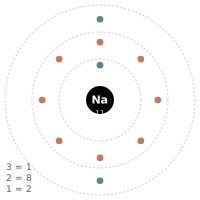
[Ne]3s1
Electrons are arranged in shells (principal energy levels) around the nucleus. The diagram is a schematic — orbitals in the same shell are not drawn separately.
About Sodium
Sodium is a chemical element; it has symbol Na and atomic number 11. It is a soft, silvery-white, highly reactive metal. Sodium is an alkali metal, being in group 1 of the periodic table. Its only stable isotope is 23Na. The free metal does not occur in nature and must be prepared from compounds. Sodium is the sixth–most abundant element in the Earth's crust and exists in numerous minerals such as feldspars, sodalite, and halite (NaCl). Many salts of sodium are highly water-soluble: sodium ions have been leached by the action of water from the Earth's minerals over eons, and thus sodium and chlorine are the most common dissolved elements by weight in the oceans.
Discovery & history
Discovered: 1807 · Humphry Davy
Because of its importance in human health, salt has long been an important commodity. In medieval Europe, a compound of sodium with the Latin name of sodanum was used as a headache remedy. The name sodium is thought to originate from the Arabic suda, meaning headache, as the headache-alleviating properties of sodium carbonate or soda were well known in early times. Although sodium, sometimes called soda, had long been recognized in compounds, the metal itself was not isolated until 1807 by Sir Humphry Davy through the electrolysis of sodium hydroxide. In 1809, the German physicist and chemist Ludwig Wilhelm Gilbert proposed the names Natronium for Humphry Davy's "sodium" and Kalium for Davy's "potassium". The chemical abbreviation for sodium was first published in 1814 by Jöns Jakob Berzelius in his system of atomic symbols, and is an abbreviation of the element's Neo-Latin name natrium,
Uses & applications
Many organosodium compounds have been prepared. Because of the high polarity of the C-Na bonds, they behave like sources of carbanions (salts with organic anions). Some well-known derivatives include sodium cyclopentadienide (NaC5H5) and trityl sodium ((C6H5)3CNa). Sodium naphthalene, Na+[C10H8•]−, a strong reducing agent, forms upon mixing Na and naphthalene in ethereal solutions.
Isotopes
Twenty isotopes of sodium are known, but only 23Na is stable. 23Na is created in the carbon-burning process in stars by fusing two carbon atoms together; this requires temperatures above 600 megakelvins and a star of at least three solar masses. Two radioactive, cosmogenic isotopes are the byproduct of cosmic ray spallation: 22Na has a half-life of 2.6 years and 24Na, a half-life of 15 hours; all other isotopes have a half-life of less than one minute. Two nuclear isomers have been discovered, the longer-lived one being 24mNa with a half-life of around 20.2 milliseconds. Acute neutron radiation, as from a nuclear criticality accident, converts some of the stable 23Na in human blood to 24Na; the neutron radiation dosage of a victim can be calculated by measuring the concentration of 24Na relative to 23Na.
Advertisement
Frequently asked questions
What is the atomic number of Sodium?
The atomic number of Sodium is 11, which equals the number of protons in its nucleus.
What is the atomic mass of Sodium?
The atomic mass of Sodium is approximately 22.9898 u (one twelfth of the mass of a carbon-12 atom).
What is the electron configuration of Sodium?
The electron configuration of Sodium is [Ne]3s1.
Where is Sodium in the periodic table?
Sodium is located in period 3, group 1.
When was Sodium discovered?
Sodium was discovered in 1807.