锔 (Cm)
锕系元素 · 固态 · 周期 7 · 族 3
元素属性
- 原子序数
- 96
- 符号
- Cm
- 原子质量
- 247.0703
- 分类
- 锕系元素
- 标准状态
- 固态
- 周期
- 7
- 族
- 3
- 电负性
- 1.3
- 原子半径
- 245
- 电离能
- 6.02
- 电子亲和力
- —
- 氧化态
- +3
- 熔点
- 1618 K (1344.85 °C)
- 沸点
- 3400 K (3126.85 °C)
- 密度
- 13.51
- 电子排布
- [Rn]7s2 5f7 6d1
- 发现年份
- 1944
电子壳层
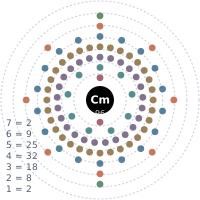
[Rn]7s2 5f7 6d1
电子围绕原子核按壳层(主能量级)排列。此图为示意图,同一壳层中的轨道未分别绘制。
关于锔
Curium is a synthetic chemical element; it has symbol Cm and atomic number 96. This transuranic actinide element was named after eminent scientists Marie and Pierre Curie, both known for their research on radioactivity. Curium was first intentionally made by the team of Glenn T. Seaborg, Ralph A. James, and Albert Ghiorso in 1944, using the cyclotron at Berkeley. They bombarded the newly discovered element plutonium with alpha particles. This was then sent to the Metallurgical Laboratory at the University of Chicago where a tiny sample of curium was eventually separated and identified. The discovery was kept secret until after the end of World War II. The news was released to the public in November 1947. Most curium is produced by bombarding uranium or plutonium with neutrons in nuclear reactors – one tonne of spent nuclear fuel contains ~20 grams of curium.
发现史
发现: 1944 · Glenn Theodore Seaborg
Curium was first intentionally synthesized, isolated and identified in 1944, at University of California, Berkeley, by Glenn T. Seaborg, Ralph A. James, and Albert Ghiorso. In their experiments, they used a 60-inch (150 cm) cyclotron. Curium was chemically identified at the Metallurgical Laboratory (now Argonne National Laboratory), University of Chicago. It was the third transuranium element to be discovered even though it is the fourth in the series – the lighter element americium was still unknown. The sample was prepared as follows: first plutonium nitrate solution was coated on a platinum foil of ~0.5 cm2 area, the solution was evaporated and the residue was converted into plutonium(IV) oxide (PuO2) by annealing. Following cyclotron irradiation of the oxide, the coating was dissolved with nitric acid and then precipitated as the hydroxide using concentrated aqueous ammonia solution.
用途与应用
The longest-lived isotope, 247Cm, has half-life 15.6 million years; so any primordial curium, that is, present on Earth when it formed, would have decayed to undetectable levels by now. However, recent nearby sites of R-process nucleosynthesis process can generate 247Cm and 247Cm has been detected in geologic samples from deep ocean floor drill cores . Its past presence as an extinct radionuclide is detectable as an excess of its primordial, long-lived daughter 235U. Traces of 242Cm may occur naturally in uranium minerals due to neutron capture and beta decay (238U → 239Pu → 240Pu → 241Am → 242Cm), though the quantities would be tiny and this has not been confirmed: even with "extremely generous" estimates for neutron absorption possibilities, the quantity of 242Cm present in 1 × 10⁸ kg of 18% uranium pitchblende would not even be one atom. Traces of 247Cm are also probably brought to Ea
同位素
About 19 radioisotopes and 7 nuclear isomers, 233Cm to 251Cm, are known; none are stable. The longest half-lives are 15.6 million years (247Cm) and 348,000 years (248Cm). Other long-lived ones are 250Cm (~8300 years), 245Cm (8250 years), and 246Cm (4706 years). Curium-250 is unusual: it mainly decays by spontaneous fission (only mode observed). The most common isotopes are 242Cm and 244Cm with the half-lives 162.8 days and 18.11 years, respectively.
广告
常见问题
锔 的原子序数是多少?
锔 的原子序数是 96,等于其原子核中的质子数。
锔 的相对原子质量是多少?
锔 的相对原子质量约为 247.0703 u(以碳-12 原子质量的十二分之一为基准)。
锔 的电子排布是什么?
锔 的电子排布为 [Rn]7s2 5f7 6d1。
锔 在周期表中的位置?
锔 位于第 7 周期、第 3 族。
锔 是何时被发现的?
锔 于 1944 被发现。