钍 (Th)
锕系元素 · 固态 · 周期 7 · 族 3
元素属性
- 原子序数
- 90
- 符号
- Th
- 原子质量
- 232.038
- 分类
- 锕系元素
- 标准状态
- 固态
- 周期
- 7
- 族
- 3
- 电负性
- 1.3
- 原子半径
- 237
- 电离能
- 6.08
- 电子亲和力
- —
- 氧化态
- +4
- 熔点
- 2023 K (1749.85 °C)
- 沸点
- 5061 K (4787.85 °C)
- 密度
- 11.72
- 电子排布
- [Rn]7s2 6d2
- 发现年份
- 1828
电子壳层
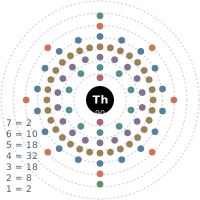
[Rn]7s2 6d2
电子围绕原子核按壳层(主能量级)排列。此图为示意图,同一壳层中的轨道未分别绘制。
关于钍
Thorium is a chemical element; it has symbol Th and atomic number 90. Thorium is a weakly radioactive light silver metal which tarnishes olive grey when it is exposed to air, forming thorium dioxide; it is moderately soft, malleable, and has a high melting point. Thorium is an electropositive actinide whose chemistry is dominated by the +4 oxidation state; it is quite reactive and can ignite in air when finely divided.
发现史
发现: 1828 · Jöns Jacob Berzelius
In 1815, the Swedish chemist Jöns Jacob Berzelius analysed an unusual sample of gadolinite from a copper mine in Falun, central Sweden. He noted impregnated traces of a white mineral, which he cautiously assumed to be an earth (oxide in modern chemical nomenclature) of an unknown element. Berzelius had already discovered two elements, cerium and selenium, but he had made a public mistake once, announcing a new element, gahnium, that turned out to be zinc oxide. Berzelius privately named the putative element "thorium" in 1817 and its supposed oxide "thorina" after Thor, the Norse god of thunder. In 1824, after more deposits of the same mineral in Vest-Agder, Norway, were discovered, he retracted his findings, as the mineral (later named xenotime) proved to be mostly yttrium orthophosphate.
用途与应用
Most binary compounds of thorium with nonmetals may be prepared by heating the elements together. In air, thorium burns to form ThO2, which has the fluorite structure. Thorium dioxide is a refractory material, with the highest melting point (3,390 °C (3,660 K)) of any known oxide. It is somewhat hygroscopic and reacts readily with water and many gases; it dissolves easily in concentrated nitric acid in the presence of fluoride. When heated in air, thorium dioxide emits intense blue light; the light becomes white when ThO2 is mixed with its lighter homologue cerium dioxide (CeO2, ceria): this is the basis for its previously common application in gas mantles. A flame is not necessary for this effect: in 1901, it was discovered that a hot Welsbach gas mantle (using ThO2 with 1% CeO2) remained at "full glow" when exposed to a cold unignited mixture of flammable gas and air. The mantle can al
同位素
There are seven naturally occurring isotopes of thorium but none are stable. 232Th is the only isotope of thorium occurring in quantity in nature; its half-life is 14.0 billion years, about three times the age of the Earth, and slightly longer than the age of the universe, and longest of all nuclides heavier than bismuth. Its stability is attributed to its closed nuclear subshell with 142 neutrons. Thorium has a characteristic terrestrial isotopic composition, with atomic weight 232.0377±0.0004. It is one of only four radioactive elements (along with bismuth, protactinium and uranium) that occur in large enough quantities on Earth for a standard atomic weight to be determined. Thorium nuclei are susceptible to alpha decay because the strong nuclear force cannot overcome the electromagnetic repulsion between their protons. The alpha decay of 232Th initiates the 4n decay chain, or thorium
广告
常见问题
钍 的原子序数是多少?
钍 的原子序数是 90,等于其原子核中的质子数。
钍 的相对原子质量是多少?
钍 的相对原子质量约为 232.038 u(以碳-12 原子质量的十二分之一为基准)。
钍 的电子排布是什么?
钍 的电子排布为 [Rn]7s2 6d2。
钍 在周期表中的位置?
钍 位于第 7 周期、第 3 族。
钍 是何时被发现的?
钍 于 1828 被发现。