борий (Bh)
Переходные металлы · Твёрдое · Период 7 · Группа 7
Свойства элементов
- Атомный номер
- 107
- Символ
- Bh
- Атомная масса
- 270.133
- Категория
- Переходные металлы
- Стандартное состояние
- Твёрдое
- Период
- 7
- Группа
- 7
- Электронная полярность
- —
- Атомный радиус
- —
- Энергия ионизации
- —
- Электронное сродство
- —
- Окислительные состояния
- 7, 5, 4, 3
- Точка плавления
- —
- Точка кипения
- —
- Плотность
- —
- Электронная конфигурация
- [Rn]7s2 5f14 6d5
- Год открытия
- 1976
Электронные оболочки
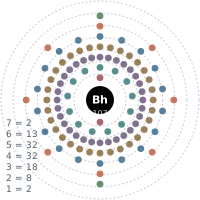
[Rn]7s2 5f14 6d5
Электроны arranged in shells (principal energy levels) around the nucleus. The diagram is a schematic — orbitals in the same shell are not drawn separately.
О борий
Bohrium is a synthetic chemical element; it has symbol Bh and atomic number 107. It is named after Danish physicist Niels Bohr. As a synthetic element, it can be created in particle accelerators but is not found in nature. All known isotopes of bohrium are highly radioactive; the most stable known isotope is 270Bh with a half-life of approximately 2.4 minutes, though the unconfirmed 278Bh may have a longer half-life of about 11.5 minutes.
Открытие и история
Открыт: 1976 · Yuri Oganessian
Two groups claimed discovery of the element. Evidence of bohrium was first reported in 1976 by a Soviet research team led by Yuri Oganessian, in which targets of bismuth-209 and lead-208 were bombarded with accelerated nuclei of chromium-54 and manganese-55, respectively. Two activities, one with a half-life of one to two milliseconds, and the other with an approximately five-second half-life, were seen. Since the ratio of the intensities of these two activities was constant throughout the experiment, it was proposed that the first was from the isotope bohrium-261 and that the second was from its daughter dubnium-257. Later, the dubnium isotope was corrected to dubnium-258, which indeed has a five-second half-life (dubnium-257 has a one-second half-life); however, the half-life observed for its parent is much shorter than the half-lives later observed in the definitive discovery of bohri
Изотопы
Bohrium has no stable or naturally occurring isotopes. Several radioactive isotopes have been synthesized in the laboratory, either by fusing two atoms or by observing the decay of heavier elements. Twelve different isotopes of bohrium have been reported with atomic masses 260–262, 264–267, 270–272, 274, and 278, one of which, bohrium-262, has a known metastable state. All of these but the unconfirmed 278Bh decay only through alpha decay, although some unknown bohrium isotopes are predicted to undergo spontaneous fission. The lighter isotopes usually have shorter half-lives; half-lives of under 100 ms for 260Bh, 261Bh, 262Bh, and 262mBh were observed. 264Bh, 265Bh, 266Bh, and 271Bh are more stable at around 1 s, and 267Bh and 272Bh have half-lives of about 10 s. The heaviest isotopes are the most stable, with 270Bh and 274Bh having measured half-lives of about 2.4 min and 40 s respective
Реклама
Частые вопросы
Каков атомный номер борий?
Атомный номер борий равен 107 и соответствует числу протонов в ядре.
Какова атомная масса борий?
Атомная масса борий составляет примерно 270.133 u (одна двенадцатая массы атома углерода-12).
Какова электронная конфигурация борий?
Электронная конфигурация борий: [Rn]7s2 5f14 6d5.
Где находится борий в периодической таблице?
борий находится в 7 периоде, 7 группе.
Когда был открыт борий?
борий был открыт в 1976 году.