уран (U)
Актиноиды · Твёрдое · Период 7 · Группа 3
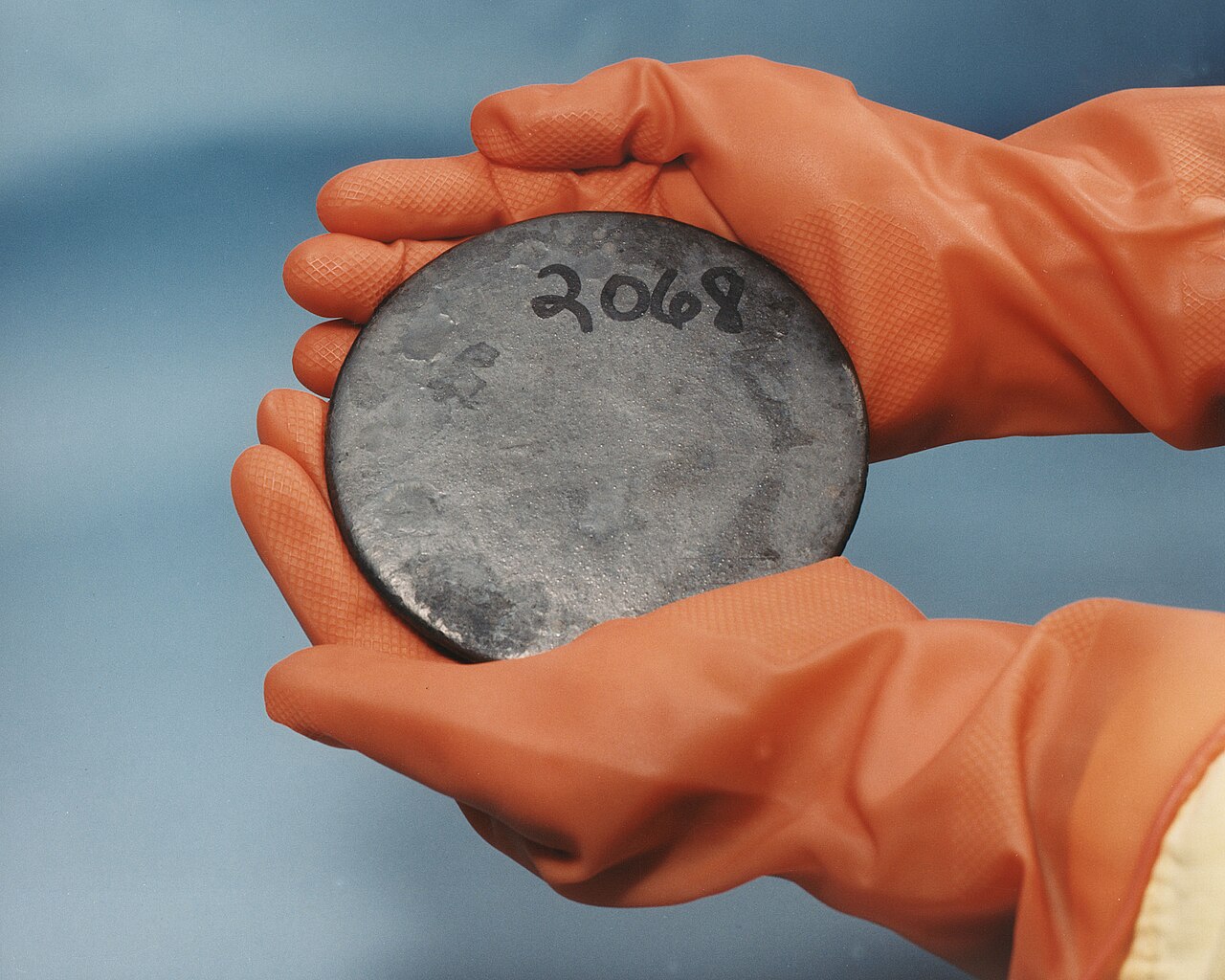
Свойства элементов
- Атомный номер
- 92
- Символ
- U
- Атомная масса
- 238.0289
- Категория
- Актиноиды
- Стандартное состояние
- Твёрдое
- Период
- 7
- Группа
- 3
- Электронная полярность
- 1.38
- Атомный радиус
- 240
- Энергия ионизации
- 6.19
- Электронное сродство
- —
- Окислительные состояния
- +6, +5, +4, +3
- Точка плавления
- 1408 K (1134.85 °C)
- Точка кипения
- 4404 K (4130.85 °C)
- Плотность
- 18.95
- Электронная конфигурация
- [Rn]7s2 5f3 6d1
- Год открытия
- 1789
Электронные оболочки
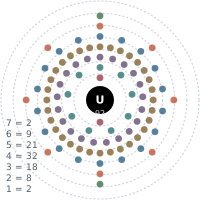
[Rn]7s2 5f3 6d1
Электроны arranged in shells (principal energy levels) around the nucleus. The diagram is a schematic — orbitals in the same shell are not drawn separately.
О уран
Uranium is a chemical element; it has symbol U and atomic number 92. It is a silvery-grey metal in the actinide series of the periodic table. A uranium atom has 92 protons and 92 electrons, of which 6 are valence electrons. Uranium radioactively decays, usually by emitting an alpha particle. The half-life of this decay varies between 159,200 and 4.5 billion years for different isotopes, making them useful for dating the age of the Earth. The most common isotopes in natural uranium are uranium-238 and uranium-235. Uranium has the highest atomic weight of the primordially occurring elements. Its density is about 70% higher than that of lead and slightly lower than that of gold or tungsten. It occurs naturally in low concentrations of a few parts per million in soil, rock and water, and is commercially extracted from uranium-bearing minerals such as uraninite.
Открытие и история
Открыт: 1789
The use of pitchblende, uranium in its natural oxide form, dates back to at least the year 79 AD, when it was used in the Roman Empire to add a yellow color to ceramic glazes. Yellow glass with 1% uranium oxide was found in a Roman villa on Cape Posillipo in the Gulf of Naples, Italy, by R. T. Gunther of the University of Oxford in 1912. Starting in the late Middle Ages, pitchblende was extracted from the Habsburg silver mines in Joachimsthal, Bohemia (now Jáchymov in the Czech Republic) in the Ore Mountains, and was used as a coloring agent in the local glassmaking industry. In the early 19th century, the world's only known sources of uranium ore were these mines.
Применение и использование
The major application of uranium in the military sector is in high-density penetrating projectiles. This ammunition consists of depleted uranium (DU) alloyed with 1–2% other elements, such as titanium or molybdenum. At high impact speed, the density, hardness, and pyrophoricity of the projectile enable the destruction of heavily armored targets. Tank armor and other removable vehicle armor can also be hardened with depleted uranium plates. The use of depleted uranium became politically and environmentally contentious after the use of such munitions by the US, UK and other countries during wars in the Persian Gulf and the Balkans raised health questions concerning uranium compounds left in the soil (see Gulf War syndrome). Depleted uranium is also used as a shielding material in some containers used to store and transport radioactive materials. While the metal itself is radioactive, its h
Изотопы
Uranium, like all elements with an atomic number greater than 82, has no stable isotopes. All isotopes of uranium are radioactive because the strong nuclear force does not prevail over electromagnetic repulsion in nuclides containing more than 82 protons. Nevertheless, the two most stable isotopes, 238U and 235U, have half-lives long enough to occur in nature as primordial radionuclides, with measurable quantities having survived since the formation of the Earth. These two nuclides, along with thorium-232, are the only confirmed primordial nuclides heavier than nearly-stable bismuth-209. Natural uranium consists of three major isotopes: uranium-238 (99.28% natural abundance), uranium-235 (0.71%), and uranium-234 (0.0054%). There are also five other trace isotopes: uranium-240, a decay product of plutonium-244; uranium-239, which is formed when 238U undergoes spontaneous fission, releasin
Реклама
Частые вопросы
Каков атомный номер уран?
Атомный номер уран равен 92 и соответствует числу протонов в ядре.
Какова атомная масса уран?
Атомная масса уран составляет примерно 238.0289 u (одна двенадцатая массы атома углерода-12).
Какова электронная конфигурация уран?
Электронная конфигурация уран: [Rn]7s2 5f3 6d1.
Где находится уран в периодической таблице?
уран находится в 7 периоде, 3 группе.
Когда был открыт уран?
уран был открыт в 1789 году.