납 (Pb)
준천이 금속 · 고체 · 주기 6 · 족 14

원소 성질
- 원자 번호
- 82
- 상징
- Pb
- 원자량
- 207
- 카테고리
- 준천이 금속
- 표준 상태
- 고체
- 주기
- 6
- 족
- 14
- 전기력
- 2.33
- 원자 반지름
- 202
- 이온화 에너지
- 7.42
- 전자친화력
- 0.36
- 산화 상태
- +4, +2
- 녹이는점
- 600.61 K (327.46 °C)
- 응고점
- 2022 K (1748.85 °C)
- 밀도
- 11.342
- 전자 구조
- [Xe]6s2 4f14 5d10 6p2
- 발견 연도
- 고대
전자殻
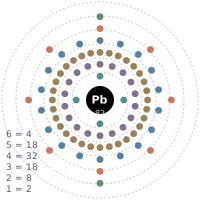
[Xe]6s2 4f14 5d10 6p2
전자는 핵 주위의殻(주요 에너지 수준)에 배열됩니다. 도표는 설계도입니다 — 같은殻의 오르비털은 별도로 그려지지 않습니다.
납에 대해
납(鑞, 영어: lead레드[*]) 또는 연(鉛←일본어: 鉛 나마리[*])은 화학 원소로, 기호는Pb(←라틴어: Plumbum플룸붐[*])이고 원자 번호는82이다. 무르고, 무겁고, 가단성의 독성이 있는 전이후 금속으로, 자르고 난 단면은 푸르스름한 빛을 띠나 공기중에서 변색이 되어 흐릿한 회색이 된다. 납은 건축, 납축전지, 총알 등에 사용되며, 땜납, 백랍 등의 가융 합금에 들어간다. 납은 안정 원소 중에 가장 원자 번호가 큰 원소이다.(비스무트도 반감기가 매우 길어 안정 원소로 취급되기도 한다.) 녹는점이 낮아 납땜에 용이하고, 납중독을 일으키며, 흡수력이 좋다. 페인트 성분에도 함유되어 있다. 자연계에서 방사성 붕괴를 하지 않는 안정된 동위원소가 포함된 마지막 원소다. 고대에는 납으로 만든 주전자나 병 등을 사용하기도 했다. 납 이온(Pb2+)의 화합물 중 질산 납(Pb(NO3)2)만 물에 잘 녹고, 염화 납(PbCl2), 황화 납(PbS), 황산 납(PbSO4), 탄산 납(PbCO3)은 물에 잘 녹지 않는다. 앙금 생성 반응을 통해 산출되는 노란색의 아이오딘화 납(PbI2)과 크롬산 납(PbCrO4), 검은색의 황화 납 앙금은 납 이온 (Pb2+)을 검출할 때 유용하다. 또한 납은 단맛이 난다. (납 중독 참고)엥
발견 과정
납은 수천 년에 걸쳐 사용되었는데, 그 이유는 널리 퍼져있고 쉽게 추출하여 작업할 수 있기 때문이다. 금속 납 구슬은 소아시아에서 기원전7,000~6,500년으로 거슬러 올라가서 볼 수 있으며 금속 제련의 최초의 예를 보여준다.
용도와 활용
Lead exhibits two principal oxidation states: +4 and +2. While the tetravalent state is characteristic of the carbon group, the divalent state is rare for carbon and silicon, less common for germanium, significant but not dominant for tin, and the most prevalent for lead. This predominance is linked to relativistic effects—specifically the inert pair effect—which occurs when there is a large electronegativity difference between lead and anions such as oxide, halide, or nitride. In such cases, lead develops a pronounced partial positive charge, causing a stronger contraction of the 6s orbital compared to the 6p orbital and rendering it relatively unreactive in ionic compounds. The inert pair effect is less pronounced in compounds where lead forms covalent bonds with elements of similar electronegativity, such as carbon in organolead compounds. In these, the 6s and 6p orbitals remain compa
동위원소
Natural lead consists of four stable isotopes with mass numbers 204, 206, 207, and 208, along with traces of six short-lived radioisotopes with mass numbers 209–214. The relatively high number of isotopes is consistent with lead's even atomic number. Lead has a magic number of protons (82), making its nucleus especially stable according to the nuclear shell model. Lead-208 also has 126 neutrons, another magic number, which may account for its exceptional stability. With its high atomic number, lead is the heaviest element whose natural isotopes are considered stable; lead-208 is the heaviest stable nucleus known. This distinction previously belonged to bismuth (atomic number 83) until its sole primordial isotope, bismuth-209, was found in 2003 to decay extremely slowly. Although the four stable isotopes of lead could theoretically undergo alpha decay to mercury isotopes with an energy re
광고
자주 묻는 질문
납의 원자번호는 얼마입니까?
납의 원자번호는 82이며, 원자핵 속 양성자 수와 같습니다.
납의 원자량은 얼마입니까?
납의 원자량은 약 207 u입니다(탄소-12 원자량의 12분의 1 기준).
납의 전자 배치는 어떻게 됩니까?
납의 전자 배치는 [Xe]6s2 4f14 5d10 6p2입니다.
납는 주기표의 어디에 있습니까?
납는 제6주기, 제14족에 위치합니다.
납는 언제 발견되었습니까?
납는 인류가 아주 오래전부터 알고 있었습니다.