오스뮴 (Os)
천이 금속 · 고체 · 주기 6 · 족 8

원소 성질
- 원자 번호
- 76
- 상징
- Os
- 원자량
- 190.2
- 카테고리
- 천이 금속
- 표준 상태
- 고체
- 주기
- 6
- 족
- 8
- 전기력
- 2.2
- 원자 반지름
- 216
- 이온화 에너지
- 8.7
- 전자친화력
- 1.1
- 산화 상태
- +4, +3
- 녹이는점
- 3306 K (3032.85 °C)
- 응고점
- 5285 K (5011.85 °C)
- 밀도
- 22.57
- 전자 구조
- [Xe]6s2 4f14 5d6
- 발견 연도
- 1803
전자殻
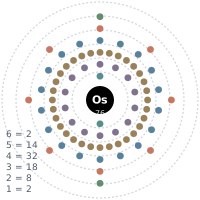
[Xe]6s2 4f14 5d6
전자는 핵 주위의殻(주요 에너지 수준)에 배열됩니다. 도표는 설계도입니다 — 같은殻의 오르비털은 별도로 그려지지 않습니다.
오스뮴에 대해
오스뮴(←영어: Osmium오즈미엄[*], 문화어: 오스미움←독일어: Osmium오스미움[*], 일본어: オスミウム 오수미우무[*])은 화학 원소로 기호는Os(←라틴어: Osmium오스미움[*]), 원자 번호는76이다.
발견 과정
발견: 1804 · Smithson Tennant
Osmium was discovered in 1803 by Smithson Tennant and William Hyde Wollaston in London, England. Its discovery is intertwined with that of platinum and the other metals of the platinum group. Platinum reached Europe as platina ("small silver"), first encountered in the late 17th century in silver mines around the Chocó Department, in Colombia. The discovery that this metal was not an alloy but a new element was published in 1748. Chemists who studied platinum dissolved it in aqua regia (a mixture of hydrochloric and nitric acids) to create soluble salts. They always observed a small amount of a dark, insoluble residue. Joseph Louis Proust thought the residue was graphite. Victor Collet-Descotils, Antoine François, comte de Fourcroy, and Louis Nicolas Vauquelin also observed iridium in the black platinum residue in 1803, but did not obtain enough material for further experiments. Later t
용도와 활용
Osmium is one of the least abundant stable elements in Earth's crust, with an average mass fraction of 50 parts per trillion in the continental crust. Osmium is found in nature as an uncombined element or in natural alloys; especially the iridium–osmium alloys, osmiridium (iridium rich), and iridosmium (osmium rich). In nickel and copper deposits, the platinum-group metals occur as sulfides (i.e., (Pt,Pd)S), tellurides (e.g., PtBiTe), antimonides (e.g., PdSb), and arsenides (e.g., PtAs2); in all these compounds platinum is exchanged by a small amount of iridium and osmium. As with all of the platinum-group metals, osmium can be found naturally in alloys with nickel or copper. Within Earth's crust, osmium, like iridium, is found at highest concentrations in three types of geologic structure: igneous deposits (crustal intrusions from below), impact craters, and deposits reworked from one o
동위원소
Osmium has seven naturally occurring isotopes, five of which are stable: 187Os, 188Os, 189Os, 190Os, and (most abundant) 192Os. At least 37 artificial radioisotopes and 20 nuclear isomers exist, with mass numbers ranging from 160 to 203; the most stable of these is 194Os with a half-life of 6.0 years. The two primordial radioisotopes 184Os and 186Os are known to undergo alpha decay, but with such long half-lives — the current best values are (1.12±0.23)×1013 and (2.0±1.1)×1015 years, approximately 140000 times the age of the universe — that for practical purposes it can be considered stable. Alpha decay is predicted for all the other naturally occurring isotopes, but has not been observed, presumably due to very long half-lives; 184Os and 192Os are also predicted to undergo double beta decay, but this not been observed either. 189Os has a spin of 3⁄2 but 187Os has a nuclear spin 1⁄2. Its
광고
자주 묻는 질문
오스뮴의 원자번호는 얼마입니까?
오스뮴의 원자번호는 76이며, 원자핵 속 양성자 수와 같습니다.
오스뮴의 원자량은 얼마입니까?
오스뮴의 원자량은 약 190.2 u입니다(탄소-12 원자량의 12분의 1 기준).
오스뮴의 전자 배치는 어떻게 됩니까?
오스뮴의 전자 배치는 [Xe]6s2 4f14 5d6입니다.
오스뮴는 주기표의 어디에 있습니까?
오스뮴는 제6주기, 제8족에 위치합니다.
오스뮴는 언제 발견되었습니까?
오스뮴는 1803년에 발견되었습니다.