어븀 (Er)
란타나이드 · 고체 · 주기 6 · 족 3

원소 성질
- 원자 번호
- 68
- 상징
- Er
- 원자량
- 167.26
- 카테고리
- 란타나이드
- 표준 상태
- 고체
- 주기
- 6
- 족
- 3
- 전기력
- 1.24
- 원자 반지름
- 235
- 이온화 에너지
- 6.11
- 전자친화력
- —
- 산화 상태
- +3
- 녹이는점
- 1802 K (1528.85 °C)
- 응고점
- 3141 K (2867.85 °C)
- 밀도
- 9.07
- 전자 구조
- [Xe]6s2 4f12
- 발견 연도
- 1843
전자殻
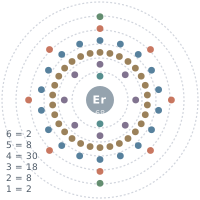
[Xe]6s2 4f12
전자는 핵 주위의殻(주요 에너지 수준)에 배열됩니다. 도표는 설계도입니다 — 같은殻의 오르비털은 별도로 그려지지 않습니다.
어븀에 대해
어븀(←영어: Erbium어비엄[*]) 또는 에르븀(문화어: 에르비움←독일어: Erbium에르비움[*])은 화학 원소로 기호는Er(←라틴어: Erbium에르비움[*]), 원자 번호는68이다. 은색의 란타넘족 금속에 속하는 희토류 원소로, 다른 희토류 원소와 함께 스웨덴의 위테르뷔에서 나는 가돌린석에서 얻는다. 광섬유에 도핑되어EDFA(Erbium Doped Fiber Amplifier) 광증폭기로 활용된다.
발견 과정
발견: 1843 · Carl Gustaf Mosander
Erbium (for Ytterby, a village in Sweden) was discovered by Carl Gustaf Mosander in 1843. Mosander was working with a sample of what was thought to be the single metal oxide yttria, derived from the mineral gadolinite. He discovered that the sample contained at least two metal oxides in addition to pure yttria, which he named "erbia" and "terbia" after the village of Ytterby where the gadolinite had been found. Mosander was not certain of the purity of the oxides and later tests confirmed his uncertainty. Not only did the "yttria" contain yttrium, erbium, and terbium; in the ensuing years, chemists, geologists and spectroscopists discovered five additional elements: ytterbium, scandium, thulium, holmium, and gadolinium. Erbia and terbia, however, were confused at this time. Marc Delafontaine, a Swiss spectroscopist, mistakenly switched the names of the two elements in his work separating
용도와 활용
Erbium(III) oxide (also known as erbia) is the only known oxide of erbium, first isolated by Carl Gustaf Mosander in 1843, and first obtained in pure form in 1905 by Georges Urbain and Charles James. It has a cubic structure resembling the bixbyite motif. The Er3+ centers are octahedral. The formation of erbium oxide is accomplished by burning erbium metal, erbium oxalate or other oxyacid salts of erbium. Erbium oxide is insoluble in water and slightly soluble in heated mineral acids. The pink-colored compound is used as a phosphor activator and to produce infrared-absorbing glass.
동위원소
Naturally occurring erbium is composed of 6 stable isotopes, 162Er, 164Er, 166Er, 167Er, 168Er, and 170Er, with 166Er being the most abundant (33.503% natural abundance). Of the artificial radioisotopes characterized, the most stable are 169Er with a half-life of 9.39 d, 172Er with a half-life of 49.3 h, and 160Er with a half-life of 28.58 h. All of the remaining radioactive isotopes have half-lives that are less than 11 h, and the majority of these have half-lives that are less than 4 minutes. This element also has 26 meta states, with the most stable being 149m1Er with a half-life of 8.9 s. The known isotopes of erbium range from 143Er to 180Er. The primary decay mode before the most abundant stable isotope, 166Er, is electron capture, and the primary mode after is beta decay. The primary decay products before 166Er are element 67 (holmium) isotopes, and the primary products after are
광고
자주 묻는 질문
어븀의 원자번호는 얼마입니까?
어븀의 원자번호는 68이며, 원자핵 속 양성자 수와 같습니다.
어븀의 원자량은 얼마입니까?
어븀의 원자량은 약 167.26 u입니다(탄소-12 원자량의 12분의 1 기준).
어븀의 전자 배치는 어떻게 됩니까?
어븀의 전자 배치는 [Xe]6s2 4f12입니다.
어븀는 주기표의 어디에 있습니까?
어븀는 제6주기, 제3족에 위치합니다.
어븀는 언제 발견되었습니까?
어븀는 1843년에 발견되었습니다.