카드뮴 (Cd)
천이 금속 · 고체 · 주기 5 · 족 12

원소 성질
- 원자 번호
- 48
- 상징
- Cd
- 원자량
- 112.41
- 카테고리
- 천이 금속
- 표준 상태
- 고체
- 주기
- 5
- 족
- 12
- 전기력
- 1.69
- 원자 반지름
- 158
- 이온화 에너지
- 8.99
- 전자친화력
- —
- 산화 상태
- +2
- 녹이는점
- 594.22 K (321.07 °C)
- 응고점
- 1040 K (766.85 °C)
- 밀도
- 8.69
- 전자 구조
- [Kr]5s2 4d10
- 발견 연도
- 1817
전자殻
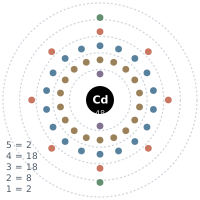
[Kr]5s2 4d10
전자는 핵 주위의殻(주요 에너지 수준)에 배열됩니다. 도표는 설계도입니다 — 같은殻의 오르비털은 별도로 그려지지 않습니다.
카드뮴에 대해
카드뮴(←영어: Cadmium캐드미엄[*], 문화어: 카드미움←독일어: Cadmium카트미움[*], 일본어: カドミウム 카도미우무[*])은 화학 원소로 기호는Cd(←라틴어: Cadmium카드미움[*]), 원자 번호는48이다. 무르고 청백색의 독성이 있는 전이 금속으로 아연 광석에서 산출되며 전지를 만드는 데 주로 쓰인다. 이 물질에 중독되면 이타이이타이 병을 일으키기도 한다.
발견 과정
발견: 1817 · Friedrich Stromeyer
Cadmium (Latin cadmia, Greek καδμεία meaning "calamine", a cadmium-bearing mixture of minerals that was named after the Greek mythological character Κάδμος, Cadmus, the founder of Thebes) was discovered in contaminated zinc compounds sold in pharmacies in Germany in 1817 by Friedrich Stromeyer. Karl Samuel Leberecht Hermann simultaneously investigated the discoloration in zinc oxide and found an impurity, first suspected to be arsenic, because of the yellow precipitate with hydrogen sulfide. Additionally Stromeyer discovered that one supplier sold zinc carbonate instead of zinc oxide. Stromeyer found the new element as an impurity in zinc carbonate (calamine), and, for 100 years, Germany remained the only important producer of the metal. The metal was named after the Latin word for calamine, because it was found in this zinc ore. Stromeyer noted that some impure samples of calamine chang
용도와 활용
Cadmium makes up about 0.1 ppm of Earth's crust and is the 65th most abundant element. It is much rarer than zinc, which makes up about 65 ppm. No significant deposits of cadmium-containing ores are known. The only cadmium mineral of importance, greenockite (CdS), is nearly always associated with sphalerite (ZnS). This association is caused by geochemical similarity between zinc and cadmium, with no geological process likely to separate them. Thus, cadmium is produced mainly as a byproduct of mining, smelting, and refining sulfidic ores of zinc, and, to a lesser degree, lead and copper. Small amounts of cadmium, about 10% of consumption, are produced from secondary sources, mainly from dust generated by recycling iron and steel scrap. Production in the United States began in 1907, but wide use began after World War I. Metallic cadmium can be found in the Vilyuy River basin in Siberia. Ro
동위원소
Naturally occurring cadmium is composed of eight isotopes. Two of them are radioactive, and three are expected to decay but have not measurably done so under laboratory conditions. The two natural radioactive isotopes are 113Cd (beta decay, half-life is 8.04×10¹⁵ y) and 116Cd (double beta decay, half-life is 2.69×10¹⁹ y). The other three are 106Cd, 108Cd (both double electron capture), and 114Cd (double beta decay); only lower limits on these half-lives have been determined. At least three isotopes – 110Cd, 111Cd, and 112Cd – are stable. Among the isotopes that do not occur naturally, the most long-lived are 109Cd with a half-life of 461.3 days, and 115Cd with a half-life of 53.46 hours. All of the remaining radioactive isotopes have half-lives of less than 7 hours, and the majority have half-lives of less than 5 minutes. Cadmium has 8 known meta states, with the most stable being 113mCd
광고
자주 묻는 질문
카드뮴의 원자번호는 얼마입니까?
카드뮴의 원자번호는 48이며, 원자핵 속 양성자 수와 같습니다.
카드뮴의 원자량은 얼마입니까?
카드뮴의 원자량은 약 112.41 u입니다(탄소-12 원자량의 12분의 1 기준).
카드뮴의 전자 배치는 어떻게 됩니까?
카드뮴의 전자 배치는 [Kr]5s2 4d10입니다.
카드뮴는 주기표의 어디에 있습니까?
카드뮴는 제5주기, 제12족에 위치합니다.
카드뮴는 언제 발견되었습니까?
카드뮴는 1817년에 발견되었습니다.