berkelio (Bk)
Actínidos · Sólido · Periodo 7 · Grupo 3

Propiedades del Elemento
- Número Atómico
- 97
- Símbolo
- Bk
- Masa Atómica
- 247.0703
- Categoría
- Actínidos
- Estado Estándar
- Sólido
- Periodo
- 7
- Grupo
- 3
- Electronegatividad
- 1.3
- Radio Atómico
- 244
- Energía de Ionización
- 6.23
- Afinidad Electrónica
- —
- Estados de Oxidación
- +4, +3
- Punto de Fusión
- 1323 K (1049.85 °C)
- Punto de Ebullición
- —
- Densidad
- 14
- Configuración Electrónica
- [Rn]7s2 5f9
- Año de Descubrimiento
- 1949
Capas electrónicas
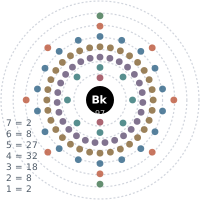
[Rn]7s2 5f9
Los electrones se organizan en capas (niveles de energía principales) alrededor del núcleo. El diagrama es un esquema — los orbitales en la misma capa no se dibujan por separado.
Sobre berkelio
El berkelio es un elemento sintético de la tabla periódica cuyo símbolo es el Bk y su número atómico es 97. Pertenece a la serie de los actínidos y elementos transuránicos. Su nombre es un homenaje a la ciudad de Berkeley, California, donde se encuentra el Laboratorio de Radiación de la Universidad de California, Lo descubrieron en 1949 S. G. Thompson, A. Ghiorso y G. T. Seaborg en la Universidad de California en Berkeley. El berkelio fue el quinto elemento transuránido sintético descubierto luego del neptunio, plutonio, curio y americio. El isótopo principal del berkelio es el berkelio-249, el cual se sintetiza en cantidades ínfimas en un reactor nuclear de alto flujo, especialmente en el Oak Ridge National Laboratory de Tennessee, Estados Unidos, y en el Research Institute of Atomic Reac
Descubrimiento e historia
Descubierto: 1949 · Glenn Theodore Seaborg
Although very small amounts of berkelium were possibly produced in previous nuclear experiments, it was first intentionally synthesized, isolated and identified in December 1949 by Glenn T. Seaborg, Albert Ghiorso, Stanley Gerald Thompson, and Kenneth Street Jr. They used the 60-inch cyclotron at the University of California, Berkeley. Similar to the nearly simultaneous discovery of americium (element 95) and curium (element 96) in 1944, the new elements berkelium and californium (element 98) were both produced in 1949–1950. The name choice for element 97 followed the previous tradition of the Californian group to draw an analogy between the newly discovered actinide and the lanthanide element positioned above it in the periodic table. Previously, americium was named after a continent as its analogue europium, and curium honored scientists Marie and Pierre Curie as the lanthanide above i
Usos y aplicaciones
All berkelium isotopes have a half-life far too short to be primordial. Therefore, any primordial berkelium − that is, berkelium present on the Earth during its formation − has decayed by now. On Earth, berkelium is mostly concentrated in certain areas, which were used for the atmospheric nuclear weapons tests between 1945 and 1980, as well as at the sites of nuclear incidents, such as the Chernobyl disaster, Three Mile Island accident and 1968 Thule Air Base B-52 crash. Analysis of the debris at the testing site of the first United States' first thermonuclear weapon, Ivy Mike, (1 November 1952, Enewetak Atoll), revealed high concentrations of various actinides, including berkelium. For reasons of military secrecy, this result was not published until 1956. Nuclear reactors produce mostly, among the berkelium isotopes, berkelium-249. During the storage and before the fuel disposal, most o
Isótopos
Twenty isotopes and six nuclear isomers (excited states of an isotope) of berkelium have been characterized, with mass numbers ranging from 233 to 253 (except 237). All of them are radioactive. The longest half-lives are observed for 247Bk (1,380 years), 248Bk (unknown, almost surely over 300 years), and 249Bk (327.2 days); other isotopes are less than a week. The isotope which is the easiest to synthesize (reactor neutron capture) is berkelium-249. This emits mostly soft β-particles which are inconvenient for detection. Its alpha radiation is rather weak (1.45×10⁻³%) with respect to the β-radiation, but is sometimes used to detect this isotope. The second important berkelium isotope, berkelium-247, is beta-stable and an alpha emitter, as are most long-lived actinide isotopes.
Anuncio
Preguntas frecuentes
¿Cuál es el número atómico de berkelio?
El número atómico de berkelio es 97, que corresponde al número de protones de su núcleo.
¿Cuál es la masa atómica de berkelio?
La masa atómica de berkelio es aproximadamente 247.0703 u (un doceavo de la masa de un átomo de carbono 12).
¿Cuál es la configuración electrónica de berkelio?
La configuración electrónica de berkelio es [Rn]7s2 5f9.
¿Dónde se sitúa berkelio en la tabla periódica?
berkelio se encuentra en el periodo 7, grupo 3.
¿Cuándo se descubrió berkelio?
berkelio se descubrió en 1949.