قصدير (Sn)
المعادن ما بعد الانتقالية · صلب · الدورة 5 · المجموعة 14

خصائص العنصر
- الرقم الذري
- 50
- الرمز
- Sn
- الكتلة الذرية
- 118.71
- الحالة القياسية
- صلب
- الدورة
- 5
- المجموعة
- 14
- الإلكترونيات
- 1.96
- محيط الذرة
- 217
- طاقة التدمير
- 7.34
- الإحباط الإلكتروني
- 1.2
- حالات الأكسدة
- +4, +2
- نقطة الانصهار
- 505.08 K (231.93 °C)
- نقطة التبخر
- 2875 K (2601.85 °C)
- الكثافة
- 7.287
- تكوين الإلكترونات
- [Kr]5s2 4d10 5p2
- سنة الإكتشاف
- العصور القديمة
طبقات الإلكترونات
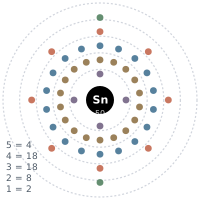
[Kr]5s2 4d10 5p2
تُرتب الإلكترونات في طبقات (الطوابق الرئيسية) حول النواة. الرسم هو تخطيطي — لا يتم رسم المدارات في نفس الطبقة بشكل منفصل.
حول قصدير
Tin is a chemical element; it has the symbol Sn and atomic number 50. A metallic-gray metal, tin is soft enough to be cut with little force, and a bar of tin can be bent by hand with little effort. When bent, a bar of tin makes a sound, the so-called "tin cry", as a result of twinning in tin crystals.
الاكتشاف والتاريخ
Tin extraction and use can be dated to the beginnings of the Bronze Age around 3000 BC, when it was observed that copper objects formed of polymetallic ores with different metal contents had different physical properties. The earliest bronze objects had a tin or arsenic content of less than 2% and are believed to be the result of unintentional alloying due to trace metal content in the copper ore. The addition of a second metal to copper increases its hardness, lowers the melting temperature, and improves the casting process by producing a more fluid melt that cools to a denser, less spongy metal. This was an important innovation that allowed for the much more complex shapes cast in closed molds of the Bronze Age. Arsenical bronze objects appear first in the Near East where arsenic is commonly found with copper ore, but the health risks were quickly realized and the quest for sources of
الاستخدامات والتطبيقات
In the great majority of its compounds, tin has the oxidation state II or IV. Compounds containing bivalent tin are called stannous while those containing tetravalent tin are termed stannic.
النظائر
Tin has seven to ten stable isotopes, the greatest number of any element. Their mass numbers are 112, 114, 115, 116, 117, 118, 119, 120, 122, and 124. Seven, 114-120Sn, are theoretically stable, while the remaining three, 112Sn, 122Sn, and 124Sn, are potentially radioactive to double beta decay, but have not been observed to decay. Tin-120 makes up almost a third of all tin. Tin-118 and tin-116 are also common. Tin-115 is the least common stable isotope. The isotopes with even mass numbers have no nuclear spin, while those with odd mass numbers have a nuclear spin of 1/2. It is thought that tin has such a great multitude of stable isotopes because of tin's atomic number being 50, which is a "magic number" in nuclear physics. Tin is one of the easiest elements to detect and analyze by NMR spectroscopy, which relies on molecular weight and its chemical shifts are referenced against tetrame
إعلان
الأسئلة الشائعة
ما هو العدد الذري لـ قصدير؟
العدد الذري لـ قصدير هو 50، وهو يساوي عدد البروتونات في نواتحه.
ما هي الكتلة الذرية لـ قصدير؟
الكتلة الذرية لـ قصدير هي نحو 118.71 u (واحد على اثنتي عشرة من كتلة ذرة الكربون 12).
ما هو التوزيع الإلكتروني لـ قصدير؟
التوزيع الإلكتروني لـ قصدير هو [Kr]5s2 4d10 5p2.
أين يقع قصدير في الجدول الدوري؟
يقع قصدير في الدورة 5 والمجموعة 14.
متى اكتُشف قصدير؟
قصدير معروف منذ العصور القديمة.