سترونتيوم (Sr)
المعادن القلوية الترابية · صلب · الدورة 5 · المجموعة 2

خصائص العنصر
- الرقم الذري
- 38
- الرمز
- Sr
- الكتلة الذرية
- 87.62
- الحالة القياسية
- صلب
- الدورة
- 5
- المجموعة
- 2
- الإلكترونيات
- 0.95
- محيط الذرة
- 249
- طاقة التدمير
- 5.7
- الإحباط الإلكتروني
- —
- حالات الأكسدة
- +2
- نقطة الانصهار
- 1050 K (776.85 °C)
- نقطة التبخر
- 1655 K (1381.85 °C)
- الكثافة
- 2.64
- تكوين الإلكترونات
- [Kr]5s2
- سنة الإكتشاف
- 1790
طبقات الإلكترونات
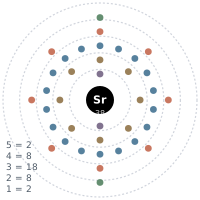
[Kr]5s2
تُرتب الإلكترونات في طبقات (الطوابق الرئيسية) حول النواة. الرسم هو تخطيطي — لا يتم رسم المدارات في نفس الطبقة بشكل منفصل.
حول سترونتيوم
Strontium is a chemical element; it has symbol Sr and atomic number 38. An alkaline earth metal, it is a soft silver-white yellowish metallic element that is highly chemically reactive. The metal forms a dark oxide layer when it is exposed to air. Strontium has physical and chemical properties similar to those of its two vertical neighbors in the periodic table, calcium and barium. It occurs naturally mainly in the minerals celestine and strontianite, and is mostly mined from these.
الاكتشاف والتاريخ
تاريخ الاكتشاف: 1787 · William Cruickshank
Strontium is named after the Scottish village of Strontian (Scottish Gaelic: Sròn an t-Sìthein), where it was discovered in the ores of the lead mines. In 1790, Adair Crawford, a physician engaged in the preparation of barium, and his colleague William Cruickshank, recognised that the Strontian ores exhibited properties that differed from those in other "heavy spars" sources. This allowed Crawford to conclude on page 355 "... it is probable indeed, that the scotch mineral is a new species of earth which has not hitherto been sufficiently examined." The physician and mineral collector Friedrich Gabriel Sulzer analysed together with Johann Friedrich Blumenbach the mineral from Strontian and named it strontianite. He also came to the conclusion that it was distinct from the witherite and contained a new earth (neue Grunderde). In 1793 Thomas Charles Hope, a professor of chemistry at the Uni
الاستخدامات والتطبيقات
Strontium commonly occurs in nature, being the 15th most abundant element on Earth (its heavier congener barium being the 14th), estimated to average approximately 360 parts per million in the Earth's crust and is found chiefly in two mineral forms: the sulfate (celestine, SrSO4) and the carbonate (strontianite, SrCO3). Of the two, celestine occurs much more frequently in deposits of sufficient size for mining. Because strontium is used most often in the carbonate form, strontianite would be the more useful of the two common minerals, but few deposits have been discovered that are suitable for development. Because of the way it reacts with air and water, strontium only exists in nature when combined to form minerals. Naturally occurring strontium is stable, but its synthetic isotope Sr-90 is only produced by nuclear fallout. In groundwater, strontium behaves chemically much like calcium.
النظائر
Natural strontium is a mixture of four stable isotopes: 84Sr, 86Sr, 87Sr, and 88Sr. Of these isotopes, 88Sr is the most abundant, making up about 82.6% of all natural strontium, though the abundance varies somewhat due to the production of radiogenic 87Sr as the daughter of long-lived beta-decaying 87Rb. This is the basis of rubidium–strontium dating. Of the unstable isotopes, the primary decay mode of the isotopes lighter than 86Sr is electron capture or positron emission to isotopes of rubidium, and that of the isotopes heavier than 88Sr is electron emission to isotopes of yttrium. Of special note are 89Sr and 90Sr. The former has a half-life of 50.56 days and is used to treat bone cancer due to strontium's chemical similarity and hence ability to replace calcium. While 90Sr (half-life 28.91 years) has been used similarly, it is more an isotope of concern in fallout from nuclear weapon
إعلان
الأسئلة الشائعة
ما هو العدد الذري لـ سترونتيوم؟
العدد الذري لـ سترونتيوم هو 38، وهو يساوي عدد البروتونات في نواتحه.
ما هي الكتلة الذرية لـ سترونتيوم؟
الكتلة الذرية لـ سترونتيوم هي نحو 87.62 u (واحد على اثنتي عشرة من كتلة ذرة الكربون 12).
ما هو التوزيع الإلكتروني لـ سترونتيوم؟
التوزيع الإلكتروني لـ سترونتيوم هو [Kr]5s2.
أين يقع سترونتيوم في الجدول الدوري؟
يقع سترونتيوم في الدورة 5 والمجموعة 2.
متى اكتُشف سترونتيوم؟
اكتُشف سترونتيوم عام 1790.