錫 (Sn)
後過渡金屬 · 固態 · 週期 5 · 族 14
元素屬性
- 原子序數
- 50
- 符號
- Sn
- 原子質量
- 118.71
- 分類
- 後過渡金屬
- 標準狀態
- 固態
- 週期
- 5
- 族
- 14
- 電負性
- 1.96
- 原子半徑
- 217
- 離子化能
- 7.34
- 電子親和能
- 1.2
- 氧化態
- +4, +2
- 熔點
- 505.08 K (231.93 °C)
- 沸點
- 2875 K (2601.85 °C)
- 密度
- 7.287
- 電子排布
- [Kr]5s2 4d10 5p2
- 發現年份
- 古代
電子層
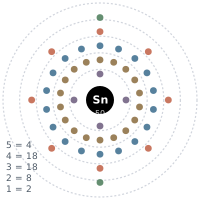
[Kr]5s2 4d10 5p2
電子按層(主能級)排列在原子核周圍。此圖為示意圖——同一層的軌道不會分開繪製。
關於錫
Tin is a chemical element; it has the symbol Sn and atomic number 50. A metallic-gray metal, tin is soft enough to be cut with little force, and a bar of tin can be bent by hand with little effort. When bent, a bar of tin makes a sound, the so-called "tin cry", as a result of twinning in tin crystals.
發現史
Tin extraction and use can be dated to the beginnings of the Bronze Age around 3000 BC, when it was observed that copper objects formed of polymetallic ores with different metal contents had different physical properties. The earliest bronze objects had a tin or arsenic content of less than 2% and are believed to be the result of unintentional alloying due to trace metal content in the copper ore. The addition of a second metal to copper increases its hardness, lowers the melting temperature, and improves the casting process by producing a more fluid melt that cools to a denser, less spongy metal. This was an important innovation that allowed for the much more complex shapes cast in closed molds of the Bronze Age. Arsenical bronze objects appear first in the Near East where arsenic is commonly found with copper ore, but the health risks were quickly realized and the quest for sources of
用途與應用
In the great majority of its compounds, tin has the oxidation state II or IV. Compounds containing bivalent tin are called stannous while those containing tetravalent tin are termed stannic.
同位素
Tin has seven to ten stable isotopes, the greatest number of any element. Their mass numbers are 112, 114, 115, 116, 117, 118, 119, 120, 122, and 124. Seven, 114-120Sn, are theoretically stable, while the remaining three, 112Sn, 122Sn, and 124Sn, are potentially radioactive to double beta decay, but have not been observed to decay. Tin-120 makes up almost a third of all tin. Tin-118 and tin-116 are also common. Tin-115 is the least common stable isotope. The isotopes with even mass numbers have no nuclear spin, while those with odd mass numbers have a nuclear spin of 1/2. It is thought that tin has such a great multitude of stable isotopes because of tin's atomic number being 50, which is a "magic number" in nuclear physics. Tin is one of the easiest elements to detect and analyze by NMR spectroscopy, which relies on molecular weight and its chemical shifts are referenced against tetrame
廣告
常見問題
錫 的原子序數是多少?
錫 的原子序數是 50,等於其原子核中的質子數。
錫 的相對原子質量是多少?
錫 的相對原子質量約為 118.71 u(以碳-12 原子質量的十二分之一為基準)。
錫 的電子排布是什麼?
錫 的電子排布為 [Kr]5s2 4d10 5p2。
錫 在週期表中的位置?
錫 位於第 5 週期、第 14 族。
錫 是何時被發現的?
錫 自古以來就為人所知。