镉 (Cd)
过渡金属 · 固态 · 周期 5 · 族 12
元素属性
- 原子序数
- 48
- 符号
- Cd
- 原子质量
- 112.41
- 分类
- 过渡金属
- 标准状态
- 固态
- 周期
- 5
- 族
- 12
- 电负性
- 1.69
- 原子半径
- 158
- 电离能
- 8.99
- 电子亲和力
- —
- 氧化态
- +2
- 熔点
- 594.22 K (321.07 °C)
- 沸点
- 1040 K (766.85 °C)
- 密度
- 8.69
- 电子排布
- [Kr]5s2 4d10
- 发现年份
- 1817
电子壳层
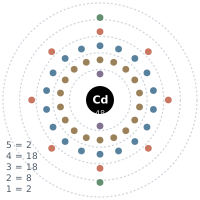
[Kr]5s2 4d10
电子围绕原子核按壳层(主能量级)排列。此图为示意图,同一壳层中的轨道未分别绘制。
关于镉
Cadmium is a chemical element; it has symbol Cd and atomic number 48. This soft, silvery-white metal is chemically similar to the two other stable metals in group 12, zinc and mercury. Like zinc, it demonstrates oxidation state +2 in most of its compounds, and like mercury, it has a lower melting point than the transition metals in groups 3 through 11. Cadmium and its congeners in group 12 are often not considered transition metals, in that they do not have partly filled d or f electron shells in the elemental or common oxidation states. The average concentration of cadmium in Earth's crust is between 0.1 and 0.5 parts per million (ppm). It was discovered in 1817 simultaneously by Stromeyer and Hermann, both in Germany, as an impurity in zinc carbonate.
发现史
发现: 1817 · Friedrich Stromeyer
Cadmium (Latin cadmia, Greek καδμεία meaning "calamine", a cadmium-bearing mixture of minerals that was named after the Greek mythological character Κάδμος, Cadmus, the founder of Thebes) was discovered in contaminated zinc compounds sold in pharmacies in Germany in 1817 by Friedrich Stromeyer. Karl Samuel Leberecht Hermann simultaneously investigated the discoloration in zinc oxide and found an impurity, first suspected to be arsenic, because of the yellow precipitate with hydrogen sulfide. Additionally Stromeyer discovered that one supplier sold zinc carbonate instead of zinc oxide. Stromeyer found the new element as an impurity in zinc carbonate (calamine), and, for 100 years, Germany remained the only important producer of the metal. The metal was named after the Latin word for calamine, because it was found in this zinc ore. Stromeyer noted that some impure samples of calamine chang
用途与应用
Cadmium makes up about 0.1 ppm of Earth's crust and is the 65th most abundant element. It is much rarer than zinc, which makes up about 65 ppm. No significant deposits of cadmium-containing ores are known. The only cadmium mineral of importance, greenockite (CdS), is nearly always associated with sphalerite (ZnS). This association is caused by geochemical similarity between zinc and cadmium, with no geological process likely to separate them. Thus, cadmium is produced mainly as a byproduct of mining, smelting, and refining sulfidic ores of zinc, and, to a lesser degree, lead and copper. Small amounts of cadmium, about 10% of consumption, are produced from secondary sources, mainly from dust generated by recycling iron and steel scrap. Production in the United States began in 1907, but wide use began after World War I. Metallic cadmium can be found in the Vilyuy River basin in Siberia. Ro
同位素
Naturally occurring cadmium is composed of eight isotopes. Two of them are radioactive, and three are expected to decay but have not measurably done so under laboratory conditions. The two natural radioactive isotopes are 113Cd (beta decay, half-life is 8.04×10¹⁵ y) and 116Cd (double beta decay, half-life is 2.69×10¹⁹ y). The other three are 106Cd, 108Cd (both double electron capture), and 114Cd (double beta decay); only lower limits on these half-lives have been determined. At least three isotopes – 110Cd, 111Cd, and 112Cd – are stable. Among the isotopes that do not occur naturally, the most long-lived are 109Cd with a half-life of 461.3 days, and 115Cd with a half-life of 53.46 hours. All of the remaining radioactive isotopes have half-lives of less than 7 hours, and the majority have half-lives of less than 5 minutes. Cadmium has 8 known meta states, with the most stable being 113mCd
广告
常见问题
镉 的原子序数是多少?
镉 的原子序数是 48,等于其原子核中的质子数。
镉 的相对原子质量是多少?
镉 的相对原子质量约为 112.41 u(以碳-12 原子质量的十二分之一为基准)。
镉 的电子排布是什么?
镉 的电子排布为 [Kr]5s2 4d10。
镉 在周期表中的位置?
镉 位于第 5 周期、第 12 族。
镉 是何时被发现的?
镉 于 1817 被发现。