프로탁티늄 (Pa)
악티나이드 · 고체 · 주기 7 · 족 3

원소 성질
- 원자 번호
- 91
- 상징
- Pa
- 원자량
- 231.0359
- 카테고리
- 악티나이드
- 표준 상태
- 고체
- 주기
- 7
- 족
- 3
- 전기력
- 1.5
- 원자 반지름
- 243
- 이온화 에너지
- 5.89
- 전자친화력
- —
- 산화 상태
- +5, +4
- 녹이는점
- 1845 K (1571.85 °C)
- 응고점
- —
- 밀도
- 15.37
- 전자 구조
- [Rn]7s2 5f2 6d1
- 발견 연도
- 1913
전자殻
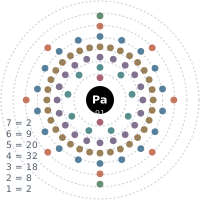
[Rn]7s2 5f2 6d1
전자는 핵 주위의殻(주요 에너지 수준)에 배열됩니다. 도표는 설계도입니다 — 같은殻의 오르비털은 별도로 그려지지 않습니다.
프로탁티늄에 대해
프로트악티늄(문화어: 프로트악티니움, ←영어: Protactinium프로택티니엄[*], 독일어: Protactinium프로탁티니움[*])은 화학 원소로 기호는Pa(←라틴어: Protactinium프로탁티니움[*]), 원자 번호는91이다.
발견 과정
발견: 1917 · Kazimierz Fajans
1871년, 드미트리 멘델레예프는 주기율표에서 빠져 있는 토륨과 우라늄 사이에 원소의 존재를 예측, "예카탄탈럼"(eka-tantalum)이라 불렀다. 당시에는 악티늄족이 알려지기 전으로, 멘델레예프는 우라늄을 텅스텐 아래에, 토륨을 지르코늄 아래에 배치했다. 화학자들은 탄탈럼 아래의 빈 자리에 해당하는 원소를 찾으려 노력했다. 1900년, 윌리엄 크룩스는 우라늄에서 강한 방사선을 지닌 프로트악티늄을 분리해냈다. 하지만 크룩스는 새로운 화학 원소라는 것을 밝히지 못하고 단지 우라늄-X라고 명명했다. 1913년, 카지미에시 파얀스와 오스발트 헬무트 괴링은 우라늄-238의 붕괴 사슬에서 프로트악티늄-234를 발견하고, 6.7시간의 짧은 반감기를 갖는 이 새로운 원소에 브레븀(brevium, 라틴어의 짧다는 뜻의brevis에서 왔음)이라는 이름을 붙였다. 1917/18년, 독일의 오토 한과 리제 마이트너, 영국의 프레더릭 소디와 존 크랜스턴은 독자적으로32,000의 긴 반감기를 갖는 새로운 동위 원소 프로트악티늄-231를 발견, 프로토악티늄(protoactinium)이라는 이름을 븥였다. 이는 우라늄-235가 악티늄으로 붕괴하는 붕괴 사슬의 일부이기 때문이다. 발음의 편의를 위해1949년, IUPAC은 프로토악티늄은 프로트악티늄(protactinium)으로 이름을 바꾸었다.
용도와 활용
Protactinium is one of the rarest and most expensive naturally occurring elements. It is found in the form of two isotopes, 231Pa and 234Pa, with the isotope 234Pa occurring in two different energy states. Nearly all natural protactinium is 231Pa. It is an alpha emitter and is formed by the decay of uranium-235, whereas the beta-radiating 234Pa is produced as a result of uranium-238 decay. Nearly all uranium-238 (99.8%) decays first to the shorter-lived 234mPa isomer. Protactinium occurs in uraninite (pitchblende) at concentrations of about 0.3–3 parts 231Pa per million parts (ppm) of ore. Whereas the usual content is closer to 0.3 ppm (e.g. in Jáchymov, Czech Republic), some ores from the Democratic Republic of the Congo have about 3 ppm. Protactinium is homogeneously dispersed in most natural materials and in water, but at much lower concentrations on the order of one part per trillion
동위원소
Thirty radioisotopes of protactinium have been discovered, ranging from 210Pa to 239Pa. The most stable are 231Pa with a half-life of 32,650 years, 233Pa with a half-life of 26.975 days, and 230Pa with a half-life of 17.4 days. All other isotopes have half-lives shorter than 1.6 days, and the majority of these have half-lives less than 1.8 seconds. Protactinium also has six nuclear isomers, with the most stable being 234mPa (half-life 1.159 minutes). The primary decay mode for the most stable isotope 231Pa and lighter isotopes (210Pa to 227Pa) is alpha decay, producing isotopes of actinium. The primary decay mode for 228Pa to 230Pa is electron capture or beta plus decay, producing isotopes of thorium, while the primary decay mode for the heavier isotopes (232Pa to 239Pa) is beta decay, producing isotopes of uranium.
광고
자주 묻는 질문
프로탁티늄의 원자번호는 얼마입니까?
프로탁티늄의 원자번호는 91이며, 원자핵 속 양성자 수와 같습니다.
프로탁티늄의 원자량은 얼마입니까?
프로탁티늄의 원자량은 약 231.0359 u입니다(탄소-12 원자량의 12분의 1 기준).
프로탁티늄의 전자 배치는 어떻게 됩니까?
프로탁티늄의 전자 배치는 [Rn]7s2 5f2 6d1입니다.
프로탁티늄는 주기표의 어디에 있습니까?
프로탁티늄는 제7주기, 제3족에 위치합니다.
프로탁티늄는 언제 발견되었습니까?
프로탁티늄는 1913년에 발견되었습니다.