protactinium (Pa)
Actinides · Solide · Période 7 · Groupe 3
Propriétés des Éléments
- Numéro Atomique
- 91
- Symbole
- Pa
- Masse Atomique
- 231.0359
- Catégorie
- Actinides
- État Standard
- Solide
- Période
- 7
- Groupe
- 3
- Électronegativité
- 1.5
- Rayon Atomique
- 243
- Énergie d'Ionisation
- 5.89
- Affinité Électronique
- —
- États d'Oxydation
- +5, +4
- Point de Fusion
- 1845 K (1571.85 °C)
- Point d'Ébullition
- —
- Densité
- 15.37
- Configuration Électronique
- [Rn]7s2 5f2 6d1
- Année de Découverte
- 1913
Couches électroniques
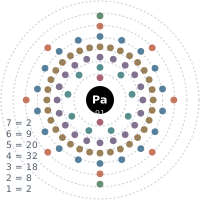
[Rn]7s2 5f2 6d1
Les électrons sont organisés en couches (niveaux d'énergie principaux) autour du noyau. Le schéma est schématique — les orbitales de la même couche ne sont pas dessinées séparément.
À propos de protactinium
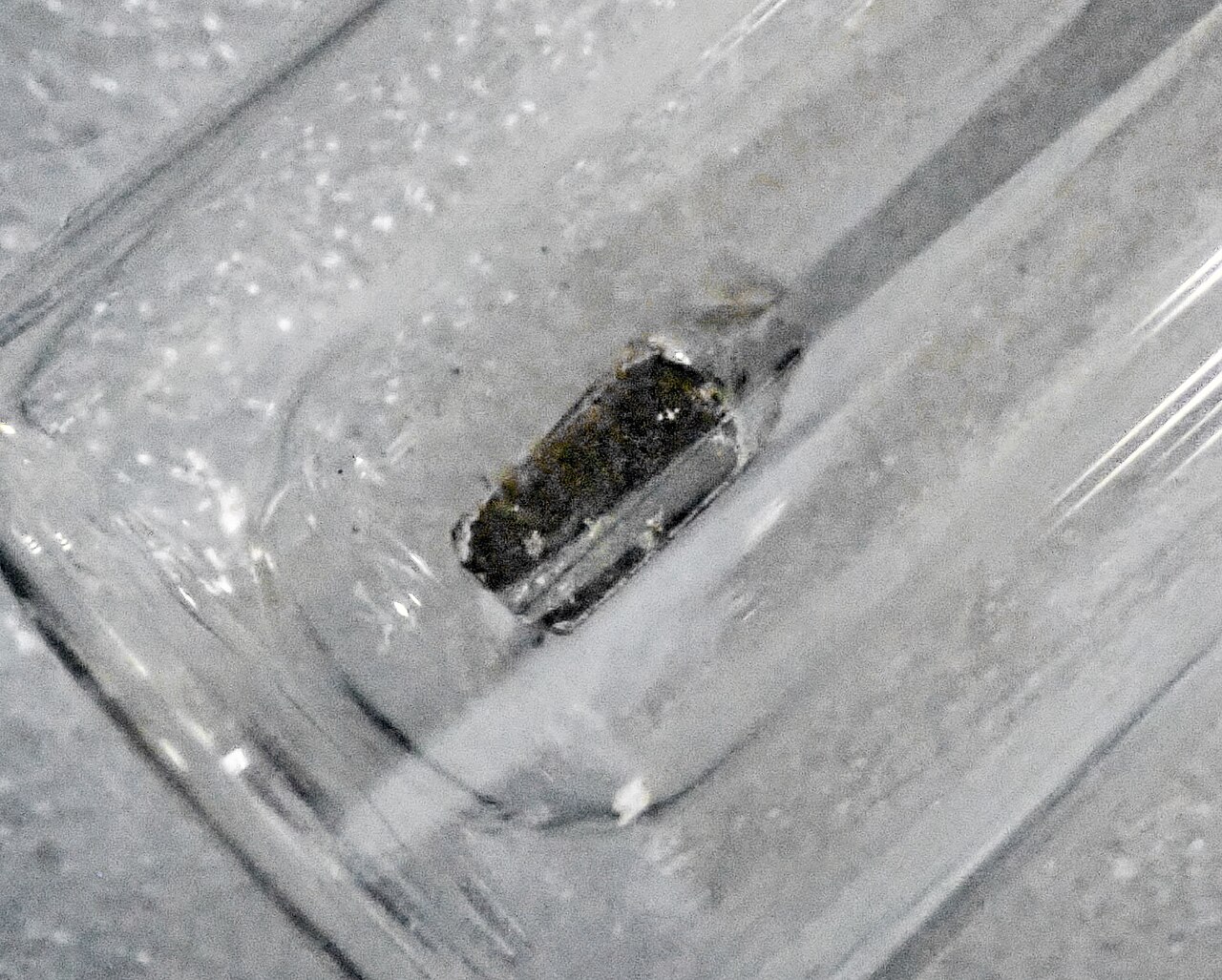
Protactinium is a chemical element; it has symbol Pa and atomic number 91. It is a dense, radioactive, silvery-gray actinide metal which readily reacts with oxygen, water vapor, and inorganic acids. It forms various chemical compounds, in which protactinium is usually present in the oxidation state +5, but it can also assume +4 and even +3 or +2 states. Concentrations of protactinium in the Earth's crust are typically a few parts per trillion, but may reach up to a few parts per million in some uraninite ore deposits. Because of its scarcity, high radioactivity, and high toxicity, there are currently no uses for protactinium outside scientific research, and for this purpose, protactinium is mostly extracted from spent nuclear fuel. It is also the only highly radioactive mononuclidic element that is not also monoisotopic, occurring almost exclusively through the decay of Uranium-235.
Découverte et histoire
Découvert: 1917 · Kazimierz Fajans
In 1871, Dmitri Mendeleev predicted the existence of an element between thorium and uranium. The actinide series was unknown at the time, so Mendeleev positioned uranium below tungsten in group VI, and thorium below zirconium in group IV, leaving the space below tantalum in group V empty. Until the general acceptance of the actinide concept in the late 1940s, periodic tables were published with this structure. For a long time, chemists searched for eka-tantalum as an element with similar chemical properties to tantalum, making a discovery of protactinium nearly impossible. Tantalum's heavier analogue was later found to be the transuranic element dubnium – although dubnium is more chemically similar to protactinium, not tantalum. In 1900, William Crookes isolated protactinium as an intensely radioactive material from uranium; however, he could not characterize it as a new chemical element
Utilisations et applications
Protactinium is one of the rarest and most expensive naturally occurring elements. It is found in the form of two isotopes, 231Pa and 234Pa, with the isotope 234Pa occurring in two different energy states. Nearly all natural protactinium is 231Pa. It is an alpha emitter and is formed by the decay of uranium-235, whereas the beta-radiating 234Pa is produced as a result of uranium-238 decay. Nearly all uranium-238 (99.8%) decays first to the shorter-lived 234mPa isomer. Protactinium occurs in uraninite (pitchblende) at concentrations of about 0.3–3 parts 231Pa per million parts (ppm) of ore. Whereas the usual content is closer to 0.3 ppm (e.g. in Jáchymov, Czech Republic), some ores from the Democratic Republic of the Congo have about 3 ppm. Protactinium is homogeneously dispersed in most natural materials and in water, but at much lower concentrations on the order of one part per trillion
Isotopes
Thirty radioisotopes of protactinium have been discovered, ranging from 210Pa to 239Pa. The most stable are 231Pa with a half-life of 32,650 years, 233Pa with a half-life of 26.975 days, and 230Pa with a half-life of 17.4 days. All other isotopes have half-lives shorter than 1.6 days, and the majority of these have half-lives less than 1.8 seconds. Protactinium also has six nuclear isomers, with the most stable being 234mPa (half-life 1.159 minutes). The primary decay mode for the most stable isotope 231Pa and lighter isotopes (210Pa to 227Pa) is alpha decay, producing isotopes of actinium. The primary decay mode for 228Pa to 230Pa is electron capture or beta plus decay, producing isotopes of thorium, while the primary decay mode for the heavier isotopes (232Pa to 239Pa) is beta decay, producing isotopes of uranium.
Publicité
Questions fréquentes
Quel est le numéro atomique de protactinium ?
Le numéro atomique de protactinium est 91, ce qui correspond au nombre de protons de son noyau.
Quelle est la masse molaire de protactinium ?
La masse molaire de protactinium est d'environ 231.0359 u (un douzième de la masse de l'atome de carbone 12).
Quelle est la configuration électronique de protactinium ?
La configuration électronique de protactinium est [Rn]7s2 5f2 6d1.
Où se situe protactinium dans le tableau périodique ?
protactinium se trouve à la période 7, groupe 3.
Quand protactinium a-t-il été découvert ?
protactinium a été découvert en 1913.