tantale (Ta)
Métaux de transition · Solide · Période 6 · Groupe 5
Propriétés des Éléments
- Numéro Atomique
- 73
- Symbole
- Ta
- Masse Atomique
- 180.9479
- Catégorie
- Métaux de transition
- État Standard
- Solide
- Période
- 6
- Groupe
- 5
- Électronegativité
- 1.5
- Rayon Atomique
- 217
- Énergie d'Ionisation
- 7.89
- Affinité Électronique
- 0.32
- États d'Oxydation
- +5
- Point de Fusion
- 3290 K (3016.85 °C)
- Point d'Ébullition
- 5731 K (5457.85 °C)
- Densité
- 16.4
- Configuration Électronique
- [Xe]6s2 4f14 5d3
- Année de Découverte
- 1802
Couches électroniques
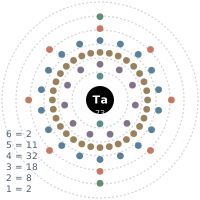
[Xe]6s2 4f14 5d3
Les électrons sont organisés en couches (niveaux d'énergie principaux) autour du noyau. Le schéma est schématique — les orbitales de la même couche ne sont pas dessinées séparément.
À propos de tantale
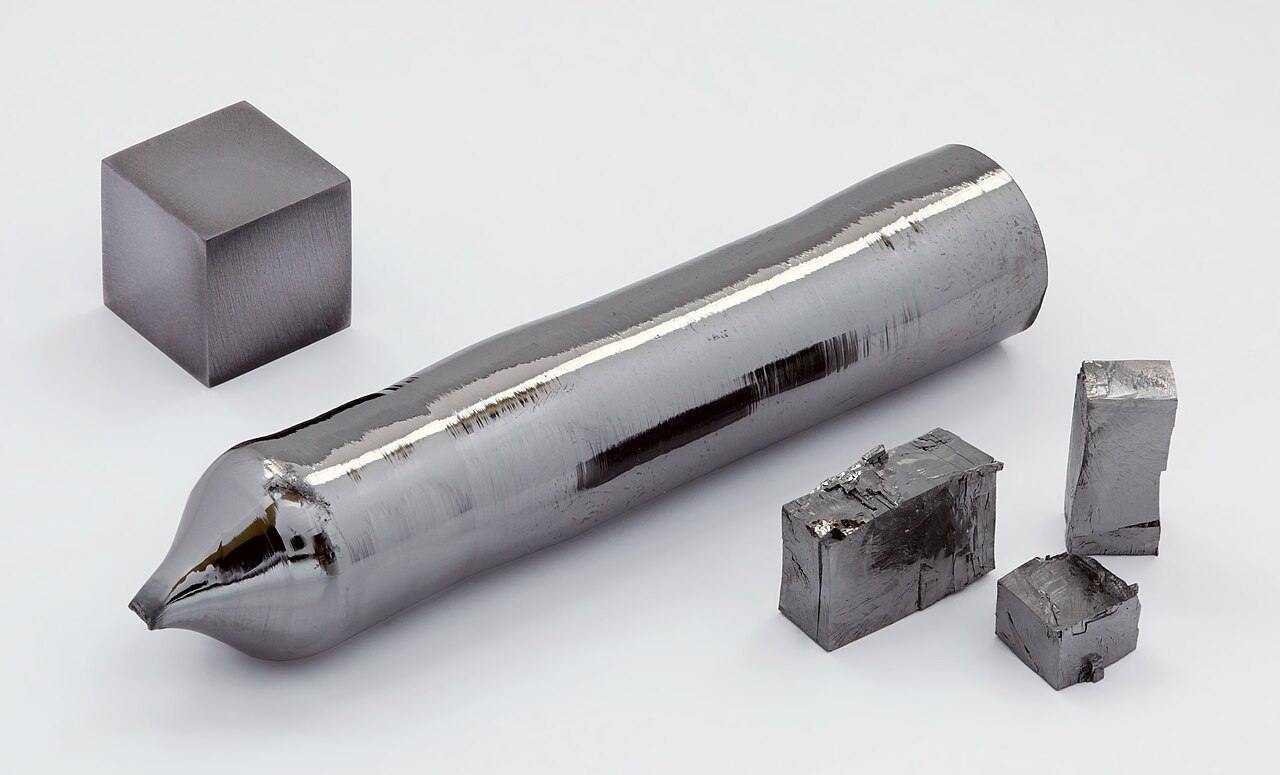
Tantalum is a chemical element; it has symbol Ta and atomic number 73. It is named after Tantalus, a figure in Greek mythology. Tantalum is a very hard, ductile, lustrous, blue-gray transition metal that is highly corrosion-resistant. It is part of the refractory metals group, which are widely used as components of strong high-melting-point alloys. It is a group 5 element, along with vanadium and niobium, and it always occurs in geologic sources together with the chemically similar niobium, mainly in the mineral groups tantalite and columbite (coltan).
Découverte et histoire
Découvert: 1802 · Anders Gustaf Ekeberg
Tantalum was discovered in Sweden in 1802 by Anders Ekeberg, in two mineral samples – one from Sweden and the other from Finland. One year earlier, Charles Hatchett had discovered niobium (then known as columbium). In 1809, the English chemist William Hyde Wollaston compared the oxides of columbium and tantalum – columbite and tantalite. Although the two oxides had different measured densities of 5.918 g/cm3 and 7.935 g/cm3, he concluded that they were identical and kept the name tantalum. After Friedrich Wöhler confirmed these results, it was thought that columbium and tantalum were the same element. This conclusion was disputed in 1846 by the German chemist Heinrich Rose, who argued that there were two additional elements in the tantalite sample, and he named them after the children of Tantalus: niobium (from Niobe), and pelopium (from Pelops). The supposed element "pelopium" was later
Utilisations et applications
Tantalum forms compounds in oxidation states −3 to +5. Most commonly encountered are oxides of Ta(V), which includes all minerals. The chemical properties of Ta and Nb are very similar. In aqueous media, Ta only exhibits the +5 oxidation state. Like niobium, tantalum is barely soluble in dilute solutions of hydrochloric, sulfuric, nitric and phosphoric acids due to the precipitation of hydrous Ta(V) oxide. In basic media, Ta can be solubilized due to the formation of polyoxotantalate species.
Isotopes
Natural tantalum consists of two stable isotopes: 180mTa (0.012%) and 181Ta (99.988%). 180mTa (m denotes a metastable state) is predicted to decay in three ways: isomeric transition to the ground state of 180Ta, beta decay to 180W, or electron capture to 180Hf. However, radioactivity of this nuclear isomer has never been observed, and only a lower limit on its half-life of 2.9×10¹⁷ years has been set. The ground state of 180Ta has a half-life of only 8 hours. Among primordial nuclides (half-life > 108 years) 180mTa is the only nuclear isomer and the rarest of all (calculated from the elemental abundance of tantalum and the isotopic abundance of 180mTa within it). Tantalum has been examined theoretically as a "salting" material for nuclear weapons (cobalt is the better-known hypothetical salting material). An external shell of tantalum would be irradiated by the intense neutron flux from
Publicité
Questions fréquentes
Quel est le numéro atomique de tantale ?
Le numéro atomique de tantale est 73, ce qui correspond au nombre de protons de son noyau.
Quelle est la masse molaire de tantale ?
La masse molaire de tantale est d'environ 180.9479 u (un douzième de la masse de l'atome de carbone 12).
Quelle est la configuration électronique de tantale ?
La configuration électronique de tantale est [Xe]6s2 4f14 5d3.
Où se situe tantale dans le tableau périodique ?
tantale se trouve à la période 6, groupe 5.
Quand tantale a-t-il été découvert ?
tantale a été découvert en 1802.