antimoine (Sb)
Métalloïdes · Solide · Période 5 · Groupe 15

Propriétés des Éléments
- Numéro Atomique
- 51
- Symbole
- Sb
- Masse Atomique
- 121.76
- Catégorie
- Métalloïdes
- État Standard
- Solide
- Période
- 5
- Groupe
- 15
- Électronegativité
- 2.05
- Rayon Atomique
- 206
- Énergie d'Ionisation
- 8.64
- Affinité Électronique
- 1.07
- États d'Oxydation
- +5, +3, -3
- Point de Fusion
- 903.78 K (630.63 °C)
- Point d'Ébullition
- 1860 K (1586.85 °C)
- Densité
- 6.685
- Configuration Électronique
- [Kr]5s2 4d10 5p3
- Année de Découverte
- Antiquité
Couches électroniques
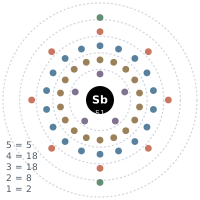
[Kr]5s2 4d10 5p3
Les électrons sont organisés en couches (niveaux d'énergie principaux) autour du noyau. Le schéma est schématique — les orbitales de la même couche ne sont pas dessinées séparément.
À propos de antimoine
Antimony is a chemical element with the symbol Sb and atomic number 51. A lustrous grey metal or metalloid, it occurs in nature mainly in the form of the sulfide mineral stibnite. Antimony compounds have been known since ancient history and were powdered for use as cosmetics and as medicine.
Découverte et histoire
Antimony(III) sulfide, Sb2S3, was recognized in predynastic Egypt as an eye cosmetic (kohl) as early as about 3100 BC, when the cosmetic palette was invented. An artifact, said to be part of a vase, made of antimony dating to about 3000 BC was found at Telloh, Chaldea (part of present-day Iraq), and a copper object plated with antimony dating between 2500 BC and 2200 BC has been found in Egypt. Austen, at a lecture by Herbert Gladstone in 1892, commented that "we only know of antimony at the present day as a highly brittle and crystalline metal, which could hardly be fashioned into a useful vase, and therefore this remarkable 'find' (artifact mentioned above) must represent the lost art of rendering antimony malleable." The British archaeologist Roger Moorey was unconvinced the artifact was indeed a vase, mentioning that Selimkhanov, after his analysis of the Tello object (published in 1
Utilisations et applications
The abundance of antimony in the Earth's crust is estimated at 0.2 parts per million, comparable to thallium at 0.5 ppm and silver at 0.07 ppm. It is the 63rd most abundant element in the crust. Even though this element is not abundant, it is found in more than 100 mineral species. Antimony is sometimes found natively (e.g. on Antimony Peak), but more frequently it is found in the sulfide stibnite (Sb2S3) which is the predominant ore mineral.
Isotopes
Antimony has two stable isotopes: 121Sb with a natural abundance of 57.21% and 123Sb with a natural abundance of 42.79%. There are 37 artificial radioactive isotopes known with mass numbers 104 to 142, of which the longest-lived is the fission product 125Sb with a half-life of 2.758 years. Numerous meta states are known, of which the most stable is 120m1Sb with a half-life of 5.76 days. Isotopes that are lighter than the stable 123Sb tend to undergo β+ decay, and those that are heavier experience β− decay, with some exceptions.
Publicité
Questions fréquentes
Quel est le numéro atomique de antimoine ?
Le numéro atomique de antimoine est 51, ce qui correspond au nombre de protons de son noyau.
Quelle est la masse molaire de antimoine ?
La masse molaire de antimoine est d'environ 121.76 u (un douzième de la masse de l'atome de carbone 12).
Quelle est la configuration électronique de antimoine ?
La configuration électronique de antimoine est [Kr]5s2 4d10 5p3.
Où se situe antimoine dans le tableau périodique ?
antimoine se trouve à la période 5, groupe 15.
Quand antimoine a-t-il été découvert ?
antimoine est connu depuis l'antiquité.