fer (Fe)
Métaux de transition · Solide · Période 4 · Groupe 8

Propriétés des Éléments
- Numéro Atomique
- 26
- Symbole
- Fe
- Masse Atomique
- 55.84
- Catégorie
- Métaux de transition
- État Standard
- Solide
- Période
- 4
- Groupe
- 8
- Électronegativité
- 1.83
- Rayon Atomique
- 194
- Énergie d'Ionisation
- 7.9
- Affinité Électronique
- 0.16
- États d'Oxydation
- +3, +2
- Point de Fusion
- 1811 K (1537.85 °C)
- Point d'Ébullition
- 3134 K (2860.85 °C)
- Densité
- 7.874
- Configuration Électronique
- [Ar]4s2 3d6
- Année de Découverte
- Antiquité
Couches électroniques
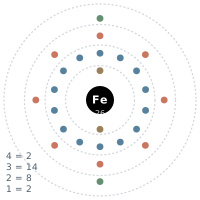
[Ar]4s2 3d6
Les électrons sont organisés en couches (niveaux d'énergie principaux) autour du noyau. Le schéma est schématique — les orbitales de la même couche ne sont pas dessinées séparément.
À propos de fer
Iron is a chemical element; it has symbol Fe and atomic number 26. It is a metal that belongs to the first transition series and group 8 of the periodic table. It is, by mass, the most common element on Earth, forming much of Earth's outer and inner core. It is the fourth most abundant element in the Earth's crust. In its metallic state it was mainly deposited by meteorites.
Découverte et histoire
Découvert: 5000 BCE
Iron is one of the elements undoubtedly known to the ancient world. It has been worked, or wrought, for millennia. However, iron artefacts of great age are much rarer than objects made of gold or silver due to the ease with which iron corrodes. The technology developed slowly, and even after the discovery of smelting it took many centuries for iron to replace bronze as the metal of choice for tools and weapons.
Utilisations et applications
Iron's abundance in rocky planets like Earth is due to its abundant production during the runaway fusion and explosion of type Ia supernovae, which scatters the iron into space. Metallic or native iron is rarely found on the surface of the Earth because it tends to oxidize. However, both the Earth's inner and outer core, which together account for 35% of the mass of the whole Earth, are believed to consist largely of an iron alloy, possibly with nickel. Electric currents in the liquid outer core are believed to be the origin of the Earth's magnetic field. The other terrestrial planets (Mercury, Venus, and Mars) as well as the Moon are believed to have a metallic core consisting mostly of iron. The M-type asteroids are also believed to be partly or mostly made of metallic iron alloy. The rare iron meteorites are the main form of natural metallic iron on the Earth's surface. Items made of
Isotopes
Iron has four stable isotopes: 54Fe (5.845% of natural iron), 56Fe (91.754%), 57Fe (2.119%) and 58Fe (0.282%). Twenty-four artificial isotopes have also been created. Of these stable isotopes, only 57Fe has a nuclear spin (−1⁄2). The nuclide 54Fe theoretically can undergo double electron capture to 54Cr, but the process has never been observed and only a lower limit on the half-life of 4.4×10²⁰ years has been established. 60Fe is an extinct radionuclide of long half-life (2.6 million years). It is not found on Earth, but its ultimate decay product is its granddaughter, the stable nuclide 60Ni. Much of the past work on isotopic composition of iron has focused on the nucleosynthesis of 60Fe through studies of meteorites and ore formation. In the last decade, advances in mass spectrometry have allowed the detection and quantification of minute, naturally occurring variations in the ratios o
Publicité
Questions fréquentes
Quel est le numéro atomique de fer ?
Le numéro atomique de fer est 26, ce qui correspond au nombre de protons de son noyau.
Quelle est la masse molaire de fer ?
La masse molaire de fer est d'environ 55.84 u (un douzième de la masse de l'atome de carbone 12).
Quelle est la configuration électronique de fer ?
La configuration électronique de fer est [Ar]4s2 3d6.
Où se situe fer dans le tableau périodique ?
fer se trouve à la période 4, groupe 8.
Quand fer a-t-il été découvert ?
fer est connu depuis l'antiquité.