plata (Ag)
Metales de transición · Sólido · Periodo 5 · Grupo 11

Propiedades del Elemento
- Número Atómico
- 47
- Símbolo
- Ag
- Masa Atómica
- 107.868
- Categoría
- Metales de transición
- Estado Estándar
- Sólido
- Periodo
- 5
- Grupo
- 11
- Electronegatividad
- 1.93
- Radio Atómico
- 172
- Energía de Ionización
- 7.58
- Afinidad Electrónica
- 1.3
- Estados de Oxidación
- +1
- Punto de Fusión
- 1234.93 K (961.78 °C)
- Punto de Ebullición
- 2435 K (2161.85 °C)
- Densidad
- 10.501
- Configuración Electrónica
- [Kr]5s1 4d10
- Año de Descubrimiento
- Antigüedad
Capas electrónicas
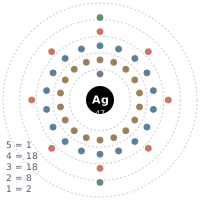
[Kr]5s1 4d10
Los electrones se organizan en capas (niveles de energía principales) alrededor del núcleo. El diagrama es un esquema — los orbitales en la misma capa no se dibujan por separado.
Sobre plata
Silver is a chemical element; it has symbol Ag and atomic number 47. A soft, white, lustrous transition metal, it exhibits the highest electrical conductivity, thermal conductivity and reflectivity of any metal. Silver is found in the Earth's crust in the pure, free elemental form, as an alloy with gold (electrum) and other metals, and in minerals such as acanthite, argentite and chlorargyrite. Most silver is recovered as a byproduct of lead–zinc, copper and gold mining and refining.
Descubrimiento e historia
Descubierto: 5000 BCE
Silver was known in prehistoric times: the three metals of group 11, copper, silver, and gold, occur in the elemental form in nature and were probably used as the first primitive forms of money as opposed to simple bartering. Unlike copper, silver did not lead to the growth of metallurgy, on account of its low structural strength; it was more often used ornamentally or as money. Since silver is more reactive than gold, supplies of native silver were much more limited than those of gold. For example, silver was more expensive than gold in Egypt until around the fifteenth century BC: the Egyptians are thought to have separated gold from silver by heating the metals with salt, and then reducing the silver chloride produced to the metal. The situation changed with the discovery of cupellation, a technique that allowed silver metal to be extracted from its ores. While slag heaps found in Asia
Usos y aplicaciones
Silver and gold have rather low chemical affinities for oxygen, lower than copper, and it is therefore expected that silver oxides are thermally quite unstable. Soluble silver(I) salts precipitate dark-brown silver(I) oxide, Ag2O, upon the addition of alkali. (The hydroxide AgOH exists only in solution; otherwise it spontaneously decomposes to the oxide.) Silver(I) oxide is very easily reduced to metallic silver, and decomposes to silver and oxygen above 160 °C. This and other silver(I) compounds may be oxidised by the strong oxidising agent peroxodisulfate to black AgO, a mixed silver(I,III) oxide of formula AgIAgIIIO2. Some other silver oxides, such as Ag2O3 and Ag3O4, are also known, as is Ag3O, which behaves as a metallic conductor. Silver(I) sulfide, Ag2S, is very readily formed from its constituent elements and is the cause of the black tarnish on some old silver objects. It may al
Isótopos
Naturally occurring silver is composed of two stable isotopes, 107Ag and 109Ag, with 107Ag being slightly more abundant (51.839% natural abundance). This almost equal abundance is rare in the periodic table. The atomic weight is 107.8682(2) Da; this value is very important because of the importance of silver compounds, particularly halides, in gravimetric analysis. Both isotopes of silver are produced in stars via the s-process (slow neutron capture), as well as in supernovas via the r-process (rapid neutron capture). Twenty-eight radioisotopes have been characterised, the most stable being 105Ag with a half-life of 41.29 days, 111Ag with a half-life of 7.45 days, and 112Ag with a half-life of 3.13 hours. Silver has numerous nuclear isomers, the most stable being 108mAg (t1/2 = 418 years), 110mAg (t1/2 = 249.79 days) and 106mAg (t1/2 = 8.28 days). All of the remaining radioactive isotope
Anuncio
Preguntas frecuentes
¿Cuál es el número atómico de plata?
El número atómico de plata es 47, que corresponde al número de protones de su núcleo.
¿Cuál es la masa atómica de plata?
La masa atómica de plata es aproximadamente 107.868 u (un doceavo de la masa de un átomo de carbono 12).
¿Cuál es la configuración electrónica de plata?
La configuración electrónica de plata es [Kr]5s1 4d10.
¿Dónde se sitúa plata en la tabla periódica?
plata se encuentra en el periodo 5, grupo 11.
¿Cuándo se descubrió plata?
plata se conoce desde la antigüedad.