أستاتين (At)
الهالوجينات · صلب · الدورة 6 · المجموعة 17

خصائص العنصر
- الرقم الذري
- 85
- الرمز
- At
- الكتلة الذرية
- 209.9872
- الفئة
- الهالوجينات
- الحالة القياسية
- صلب
- الدورة
- 6
- المجموعة
- 17
- الإلكترونيات
- 2.2
- محيط الذرة
- 202
- طاقة التدمير
- 9.5
- الإحباط الإلكتروني
- 2.8
- حالات الأكسدة
- 7, 5, 3, 1, -1
- نقطة الانصهار
- 575 K (301.85 °C)
- نقطة التبخر
- —
- الكثافة
- 7
- تكوين الإلكترونات
- [Xe]6s2 4f14 5d10 6p5
- سنة الإكتشاف
- 1940
طبقات الإلكترونات
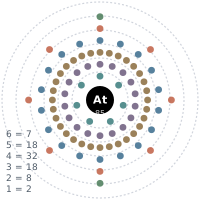
[Xe]6s2 4f14 5d10 6p5
تُرتب الإلكترونات في طبقات (الطوابق الرئيسية) حول النواة. الرسم هو تخطيطي — لا يتم رسم المدارات في نفس الطبقة بشكل منفصل.
حول أستاتين
الأستاتين الأستات (الإنجليزية: Astatine)عنصر كيميائي له الرمز At والعدد الذري (85) في الجدول الدوري، وهو عنصر مشع ويعد أثقل عناصر زمرة الهالوجينات التي ينتمي إليها.الأَسْتَاتِين أثقل عنصر في مجموعة الهالوجين الكيميائية وهو غير مستقر وتتفكك كل نظائره الثلاثين إشعاعيًا. والعمر النصفي لأكثر نظائره ثباتًا يبلغ ثماني ساعات، ووزنه الذري 210. والرمز الكيميائي للأستاتين At وعدده الذري 85، وتشبه خواصه الكيميائية خواص اليود، غير أن الأستاتين يفقد إلكتروناته في التفاعل الكيميائي بسهولة، مقارنة باليود، كما أنه أقل من اليود في اكتساب الإلكترونات. تم تحضير الأستاتين لأول مرة عام 1940م، والذي قام بتحضيره هو ديل ر. كورسون وك. ر. ماكينزي وإميليو سيجري في مدينة بيركلي بكاليفورنيا بالولايات المتحدة. وقد أُنتج داخل سايكلوترون بقذف البزْموت بجسيمات ألْفا ذات طاقة عالية. ورغم وجود كمية قليلة من العنصر في اليورا
الاكتشاف والتاريخ
تاريخ الاكتشاف: 1940 · Emilio G. Segrè
In 1869, when Dmitri Mendeleev published his periodic table, the space under iodine was empty; after Niels Bohr established the physical basis of the classification of chemical elements, it was suggested that the fifth halogen belonged there. Before its officially recognized discovery, it was called "eka-iodine" (from Sanskrit eka 'one') to imply it was one space under iodine (in the same manner as eka-silicon, eka-boron, and others). Scientists tried to find it in nature; given its extreme rarity, these attempts resulted in several false discoveries. The first claimed discovery of eka-iodine was made by Fred Allison and his associates at the Alabama Polytechnic Institute (now Auburn University) in 1931. The discoverers named element 85 "alabamine", and assigned it the symbol Ab, designations that were used for a few years. In 1934, H. G. MacPherson of University of California, Berkeley
الاستخدامات والتطبيقات
Less reactive than iodine, astatine is the least reactive of the natural halogens; the chemical properties of the artificial element tennessine, the next-heavier group 17 element, have not yet been investigated. Astatine compounds have been synthesized in nano-scale amounts and studied as intensively as possible before their radioactive disintegration. The reactions involved have been typically tested with dilute solutions of astatine mixed with larger amounts of iodine. Acting as a carrier, the iodine ensures there is sufficient material for laboratory techniques (such as filtration and precipitation) to work. Like iodine, astatine has been shown to adopt odd-numbered oxidation states ranging from −1 to +7. Only a few compounds with metals have been reported, in the form of astatides of sodium, palladium, silver, thallium, and lead. Some characteristic properties of silver and sodium as
النظائر
All of astatine's isotopes are short-lived; the most stable is astatine-210, with a half-life of 8.1 hours. There are 41 known isotopes of astatine, with mass numbers of 188 and 190–229. The two lightest isotopes, astatine-190 and astatine-188, were discovered in 2023 and 2025 respectively at the University of Jyväskylä's accelerator laboratory in Finland. Astatine-188, with a half-life of about 190 microseconds, is the heaviest nucleus known to decay by proton emission. Theoretical modeling suggests that about 37 more isotopes could exist. No stable or long-lived astatine isotope has been observed, nor is one expected to exist. Astatine's alpha decay energies follow the same trend as for other heavy elements. Lighter astatine isotopes have quite high energies of alpha decay, which become lower as the nuclei become heavier. Astatine-211 has a significantly higher energy than the previous
إعلان
الأسئلة الشائعة
ما هو العدد الذري لـ أستاتين؟
العدد الذري لـ أستاتين هو 85، وهو يساوي عدد البروتونات في نواتحه.
ما هي الكتلة الذرية لـ أستاتين؟
الكتلة الذرية لـ أستاتين هي نحو 209.9872 u (واحد على اثنتي عشرة من كتلة ذرة الكربون 12).
ما هو التوزيع الإلكتروني لـ أستاتين؟
التوزيع الإلكتروني لـ أستاتين هو [Xe]6s2 4f14 5d10 6p5.
أين يقع أستاتين في الجدول الدوري؟
يقع أستاتين في الدورة 6 والمجموعة 17.
متى اكتُشف أستاتين؟
اكتُشف أستاتين عام 1940.