تنجستن (W)
المعادن الانتقالية · صلب · الدورة 6 · المجموعة 6

خصائص العنصر
- الرقم الذري
- 74
- الرمز
- W
- الكتلة الذرية
- 183.84
- الفئة
- المعادن الانتقالية
- الحالة القياسية
- صلب
- الدورة
- 6
- المجموعة
- 6
- الإلكترونيات
- 2.36
- محيط الذرة
- 210
- طاقة التدمير
- 7.98
- الإحباط الإلكتروني
- 0.81
- حالات الأكسدة
- +6
- نقطة الانصهار
- 3695 K (3421.85 °C)
- نقطة التبخر
- 5828 K (5554.85 °C)
- الكثافة
- 19.3
- تكوين الإلكترونات
- [Xe]6s2 4f14 5d4
- سنة الإكتشاف
- 1783
طبقات الإلكترونات
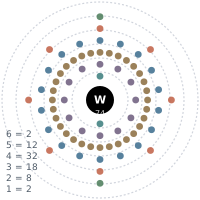
[Xe]6s2 4f14 5d4
تُرتب الإلكترونات في طبقات (الطوابق الرئيسية) حول النواة. الرسم هو تخطيطي — لا يتم رسم المدارات في نفس الطبقة بشكل منفصل.
حول تنجستن
التنجستن (ملاحظة 1) عنصر كيميائي يرمز له باللاتينية بالرمز W، وعدده الذري 74. كلمة تنجستن مشتقة من السويدية tung (ثقيل) وsten (حجر) بمعنى الحجر الثقيل. اكتشفه الكيميائي السويدي كارل فلهلم شيله في عام 1783، وهو عنصر مهم جــداً، ويستخدم في صناعة الأسلاك المتوهجة في المصابيح الكهربائية.
الاكتشاف والتاريخ
تاريخ الاكتشاف: 1783 · Juan José Elhuyar
In 1781, Carl Wilhelm Scheele discovered that a new acid, tungstic acid, could be made from scheelite (at the time called tungsten). Scheele and Torbern Bergman suggested that it might be possible to obtain a new metal by reducing this acid. In 1783, José and Fausto Elhuyar found an acid made from wolframite that was identical to tungstic acid. Later that year, at the Royal Basque Society in the town of Bergara, Spain, the brothers succeeded in isolating tungsten by reduction of this acid with charcoal, and they are credited with the discovery of the element (they called it "wolfram" or "volfram"). The strategic value of tungsten came to notice in the early 20th century. British authorities acted in 1912 to free the Carrock mine from the German owned Cumbrian Mining Company and, during World War I, restrict German access elsewhere. In World War II, tungsten played a more significant role
الاستخدامات والتطبيقات
أنتج حوالي 61,300 طن من مركزات التنغستن في عام 2009. يستخرج خامات التنغستن، على عدة مراحل. يتم تحويل المعدن الخام في نهاية المطاف إلى أكسيد tungsten(VI) (WO3)، التي يتم تسخينها مع الهيدروجين أو الكربون لإنتاج مسحوق التنغستن. ويبلغ ثمن المعدن النقي يبلغ حوالي 20,075 دولار الطن اعتبارا من تشرين الأول/أكتوبر 2008.
النظائر
Naturally occurring tungsten consists of four stable isotopes (182W, 183W, 184W, and 186W) and one very long-lived radioisotope, 180W. Theoretically, all five can decay into isotopes of element 72 (hafnium) by alpha emission, but only 180W has been observed to do so, with a half-life of (1.8±0.2)×1018 years; on average, this yields about two alpha decays of 180W per gram of natural tungsten per year. Another 34 artificial radioisotopes of tungsten have been characterized, the most stable of which are 181W with a half-life of 121.2 days, 185W with a half-life of 75.1 days, 188W with a half-life of 69.4 days, 178W with a half-life of 21.6 days, and 187W with a half-life of 23.72 h. All of the remaining radioactive isotopes have half-lives of less than 3 hours, and most of these have half-lives below 8 minutes. Tungsten also has 12 meta states, with the most stable being 179mW (t½ 6.4 minut
إعلان
الأسئلة الشائعة
ما هو العدد الذري لـ تنجستن؟
العدد الذري لـ تنجستن هو 74، وهو يساوي عدد البروتونات في نواتحه.
ما هي الكتلة الذرية لـ تنجستن؟
الكتلة الذرية لـ تنجستن هي نحو 183.84 u (واحد على اثنتي عشرة من كتلة ذرة الكربون 12).
ما هو التوزيع الإلكتروني لـ تنجستن؟
التوزيع الإلكتروني لـ تنجستن هو [Xe]6s2 4f14 5d4.
أين يقع تنجستن في الجدول الدوري؟
يقع تنجستن في الدورة 6 والمجموعة 6.
متى اكتُشف تنجستن؟
اكتُشف تنجستن عام 1783.