يوروبيوم (Eu)
اللانثانيدات · صلب · الدورة 6 · المجموعة 3

خصائص العنصر
- الرقم الذري
- 63
- الرمز
- Eu
- الكتلة الذرية
- 151.964
- الفئة
- اللانثانيدات
- الحالة القياسية
- صلب
- الدورة
- 6
- المجموعة
- 3
- الإلكترونيات
- —
- محيط الذرة
- 233
- طاقة التدمير
- 5.67
- الإحباط الإلكتروني
- —
- حالات الأكسدة
- +3, +2
- نقطة الانصهار
- 1095 K (821.85 °C)
- نقطة التبخر
- 1802 K (1528.85 °C)
- الكثافة
- 5.24
- تكوين الإلكترونات
- [Xe]6s2 4f7
- سنة الإكتشاف
- 1901
طبقات الإلكترونات
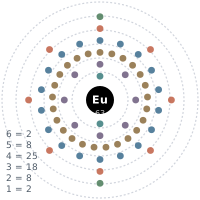
[Xe]6s2 4f7
تُرتب الإلكترونات في طبقات (الطوابق الرئيسية) حول النواة. الرسم هو تخطيطي — لا يتم رسم المدارات في نفس الطبقة بشكل منفصل.
حول يوروبيوم
اليوروبيوم عنصر كيميائي له الرمز Eu والعدد الذري 63 في الجدول الدوري وهو من اللانثانيدات.
الاكتشاف والتاريخ
تاريخ الاكتشاف: 1901 · Eugène-Anatole Demarçay
The discovery of europium was part of the prolonged separation of the rare-earth elements during the 19th century. Cerium had been discovered in 1803, and in the following decades apparently single rare-earth substances were repeatedly shown to contain further elements. Carl Gustaf Mosander separated lanthanum and didymium from cerium-containing material, while didymium itself was later resolved into praseodymium and neodymium. In 1879, Paul Émile Lecoq de Boisbaudran separated samarium from didymium, and samarium-rich material was subsequently found to contain gadolinium as well. In 1885, William Crookes observed an anomalous line in the phosphorescence spectrum of material containing samarium and yttrium, indicating the presence of an unidentified constituent. In 1892, Lecoq de Boisbaudran reported an unidentified spectral line in samarium. The French chemist Eugène-Anatole Demarçay in
الاستخدامات والتطبيقات
Europium forms a wide variety of inorganic, coordination and organometallic compounds. Unlike most lanthanides, for which the +3 oxidation state overwhelmingly dominates ordinary chemistry, europium has extensive chemistry in both the +3 and +2 states. Eu(III) is generally more stable under oxidising conditions, but the half-filled 4f7 configuration makes Eu(II) unusually accessible. The two oxidation states consequently have markedly different structural, magnetic and optical properties.
النظائر
Naturally occurring europium consists of two isotopes, 151Eu and 153Eu, in nearly equal proportions. Their standard isotopic abundances are 47.81% and 52.19%, respectively. 153Eu is observationally stable, whereas 151Eu is a primordial radioisotope. It undergoes alpha decay to 147Pm with a measured half-life of 4.62×10¹⁸ years. This half-life is about 300 million times the age of the Universe, so the decay has a negligible effect on the natural isotopic composition of europium. Artificial europium radioisotopes are known from 130Eu through 170Eu. The neutron-rich isotope 170Eu, at the upper end of this range, was first experimentally characterised in 2022 and was measured to have a half-life of 197+74−71 ms. The longest-lived artificial isotope is 150Eu, with a half-life of 36.9 years. Other comparatively long-lived isotopes are 152Eu (13.517 years), 154Eu (8.592 years) and 155Eu (4.742
إعلان
الأسئلة الشائعة
ما هو العدد الذري لـ يوروبيوم؟
العدد الذري لـ يوروبيوم هو 63، وهو يساوي عدد البروتونات في نواتحه.
ما هي الكتلة الذرية لـ يوروبيوم؟
الكتلة الذرية لـ يوروبيوم هي نحو 151.964 u (واحد على اثنتي عشرة من كتلة ذرة الكربون 12).
ما هو التوزيع الإلكتروني لـ يوروبيوم؟
التوزيع الإلكتروني لـ يوروبيوم هو [Xe]6s2 4f7.
أين يقع يوروبيوم في الجدول الدوري؟
يقع يوروبيوم في الدورة 6 والمجموعة 3.
متى اكتُشف يوروبيوم؟
اكتُشف يوروبيوم عام 1901.