نيون (Ne)
الغازات النبيلة · غازي · الدورة 2 · المجموعة 18

خصائص العنصر
- الرقم الذري
- 10
- الرمز
- Ne
- الكتلة الذرية
- 20.18
- الفئة
- الغازات النبيلة
- الحالة القياسية
- غازي
- الدورة
- 2
- المجموعة
- 18
- الإلكترونيات
- —
- محيط الذرة
- 154
- طاقة التدمير
- 21.57
- الإحباط الإلكتروني
- —
- حالات الأكسدة
- 0
- نقطة الانصهار
- 24.56 K (-248.59 °C)
- نقطة التبخر
- 27.07 K (-246.08 °C)
- الكثافة
- 0.0009
- تكوين الإلكترونات
- [He]2s2 2p6
- سنة الإكتشاف
- 1898
طبقات الإلكترونات
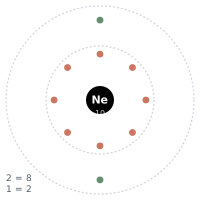
[He]2s2 2p6
تُرتب الإلكترونات في طبقات (الطوابق الرئيسية) حول النواة. الرسم هو تخطيطي — لا يتم رسم المدارات في نفس الطبقة بشكل منفصل.
حول نيون
Neon is a chemical element; it has the symbol Ne and the atomic number 10. It is the second noble gas in the periodic table. Neon is a colorless, odorless, inert monatomic gas under standard conditions, with approximately two-thirds the density of air.
الاكتشاف والتاريخ
تاريخ الاكتشاف: 1898 · William Ramsay
Neon was discovered in 1898 by the British chemists Sir William Ramsay (1852–1916) and Morris Travers (1872–1961) in London. Neon was discovered when Ramsay chilled a sample of air until it became a liquid, then warmed the liquid and captured the gases as they boiled off. The gases nitrogen, oxygen, and argon had been identified, but the remaining gases were isolated in roughly their order of abundance, in a six-week period beginning at the end of May 1898. The first remaining gas to be identified was krypton; the next, after krypton had been removed, was a gas which gave a brilliant red light under spectroscopic discharge. This gas, identified in June, was named "neon", the Greek analogue of the Latin novum ('new') suggested by Ramsay's son. The characteristic brilliant red-orange color emitted by gaseous neon when excited electrically was noted immediately. Travers later wrote: "the bl
الاستخدامات والتطبيقات
Stable isotopes of neon are produced in stars. Neon's most abundant isotope 20Ne (90.48%) is created by the nuclear fusion of carbon and carbon in the carbon-burning process of stellar nucleosynthesis. This requires temperatures above 500 megakelvins, which occur in the cores of stars of more than 8 solar masses. Neon is abundant on a universal scale; it is the fifth most abundant chemical element in the universe by mass, after hydrogen, helium, oxygen, and carbon (see chemical element). Its relative rarity on Earth, like that of helium, is due to its relative lightness, high vapor pressure at very low temperatures, and chemical inertness, all properties which tend to keep it from being trapped in the condensing gas and dust clouds that formed the smaller and warmer solid planets like Earth. Neon is monatomic, making it lighter than the molecules of diatomic nitrogen and oxygen which fo
النظائر
Neon has three stable isotopes: 20Ne (90.48%), 21Ne (0.27%) and 22Ne (9.25%). 21Ne and 22Ne are partly primordial and partly nucleogenic (i.e. made by nuclear reactions of other nuclides with neutrons or other particles in the environment) and their variations in natural abundance are well understood. In contrast, 20Ne (the chief primordial isotope made in stellar nucleosynthesis) is not known to be nucleogenic or radiogenic, except from the decay of oxygen-20, which is produced in very rare cases of cluster decay by thorium-228. The causes of the variation of 20Ne in the Earth have thus been hotly debated. The principal nuclear reactions generating nucleogenic neon isotopes start from 24Mg and 25Mg, which produce 21Ne and 22Ne respectively, after neutron capture and immediate emission of an alpha particle. The neutrons that produce the reactions are mostly produced by secondary spallati
إعلان
الأسئلة الشائعة
ما هو العدد الذري لـ نيون؟
العدد الذري لـ نيون هو 10، وهو يساوي عدد البروتونات في نواتحه.
ما هي الكتلة الذرية لـ نيون؟
الكتلة الذرية لـ نيون هي نحو 20.18 u (واحد على اثنتي عشرة من كتلة ذرة الكربون 12).
ما هو التوزيع الإلكتروني لـ نيون؟
التوزيع الإلكتروني لـ نيون هو [He]2s2 2p6.
أين يقع نيون في الجدول الدوري؟
يقع نيون في الدورة 2 والمجموعة 18.
متى اكتُشف نيون؟
اكتُشف نيون عام 1898.